
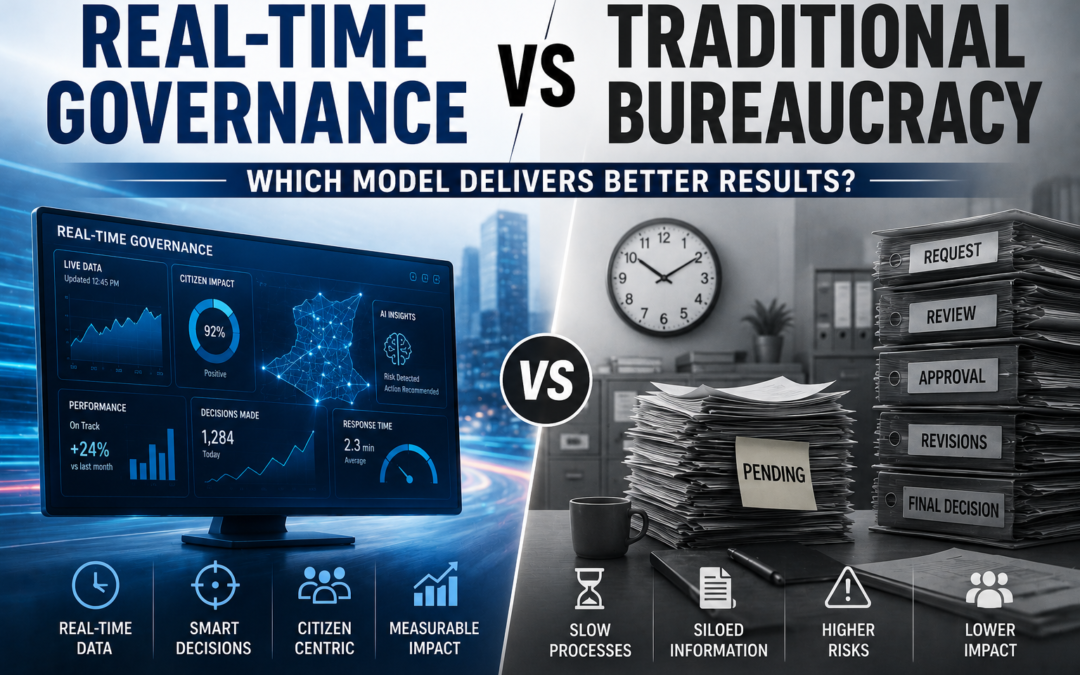
Traditional control of bureaucracy relies on periodic reviews and delayed reporting cycles. Problems are discovered months or years after citizens are already affected. One of the challenges of bureaucracy is to coordinate actions across complex organizations while maintaining accountability. Political control of bureaucracy through hierarchical oversight has structural limitations. In fact, limitations on presidential control of the federal bureaucracy illustrate how delayed feedback creates blind spots in governance.
Real-time governance offers a different approach. Instead of reacting to failures after the fact, modern digital systems enable continuous monitoring and faster response. Internal and external control of bureaucracy become more effective when institutions can identify issues before they escalate. Government should operate at the speed of the challenges it is expected to solve.
Traditional Bureaucracy and Its Control Challenges
Hierarchical Control Systems
Bureaucratic organizations arrange authority in layers, with commands flowing down and information flowing up. Democracy promises accountability via elections, while bureaucracy promises coordination via hierarchy. The structure creates an inherent tension. Each higher layer operates with longer planning intervals than lower layers, and subordinate units handle local tasks without constant override from above.
One of the challenges of bureaucracy is to sustain performance review across all levels. An obvious problem emerges: since nobody in hierarchical systems can review their superiors, inept leaders may endure indefinitely. Poor performance in parts of the organization, including top positions, may go uncorrected. Police may use deadly force inappropriately for extended periods. These problems affect all governments that rely on hierarchical institutions.
Political Control of Bureaucracy
Congress exercises oversight through funding authority and confirmation of presidential appointments. The House Oversight Committee works to ensure efficiency, effectiveness, and accountability across federal agencies. The Government Accountability Office provides auditing, evaluation, and investigative services to Congress and agency heads.
Political control operates through multiple mechanisms. Administrative procedures can enhance political control of bureaucracy by predisposing agencies toward policy choices preferred by legislators’ constituents. However, research on Medicare physician payment reform found agencies were more responsive to physicians expecting fee reductions than to intended beneficiaries, suggesting certain administrative procedures do not operate as instruments of political control.
Congress faces a principal-agent problem amplified by multiple principals. The bureaucracy answers to the president, Congress, the Senate, the House, various committees, constituents, and courts. These diverse principals represent different interests and seek to influence agency policy in different directions.
Limitations on Presidential Control of the Federal Bureaucracy
Presidential influence depends on institutional features, including whether agency leadership is insulated from removal, the agency’s location inside or outside the cabinet hierarchy, and the extent of political appointments. Congress has plenary control over salary, duties, and existence of executive offices. Agencies created and funded by Congress act on behalf of legislative authority, not presidential discretion.
The Time Gap Problem
Government agencies display high variability in decision duration. From 1993 to 1995, the FDA approved sixty-seven new chemical entities, but review times ranged from less than one month to eighty-two months. Nearly two-fifths of non-legislative hearings involved no scrutiny of agency decisions. Oversight by one House committee decreased from levels seen in the late 1970s through mid-1980s, with a step decrease occurring in 1995.
What Real-Time Governance Actually Means
Digital Tools for Instant Monitoring
Digital connectivity creates new possibilities for oversight. Infrastructure monitoring tools capture health and resource utilization data in near real time, tracking servers, containers, databases, and network devices. Government agencies use social media platforms as live monitoring systems during crises such as natural disasters, public health emergencies, and civil disturbances. Early signals from eyewitness posts and geotagged media help dispatch emergency services faster.
Smartphones serve as primary digital identifiers for citizens. In fact, India has approximately 1.3 smartphones for each person in the population of 1.2 billion. This universal connectivity enables governments to reach every citizen in real time. Digitized workflows provide policymakers with live dashboards, while social media monitoring uncovers early indicators such as coded language and follower spikes that point to operational planning.
Internal and External Control of Bureaucracy
Internal control mechanisms include bureaucratic monitoring through corporate rules and operational procedures. External control relies on citizen participation and organized interest groups to identify instances of non-compliance. Social media monitoring functions as both a defensive mechanism and a feedback loop. Agencies analyze public sentiment to gage reactions to policies, monitor changing concerns, and identify issues demanding immediate attention.
Continuous Feedback Loops
Feedback loops structure two-way communication for local authorities to listen, analyze, and address community opinions. The process follows three steps: Listen to set priorities through public feedback collection, Respond by using dialog to codesign solutions, and Report by communicating updates throughout the process. A loop must be closed. Consequently, local authorities issue updates to residents on progress made or explain how feedback was used. This closed feedback loop cultivates genuine engagement and influence over decisions.
Why Real-Time Governance Works Better Than Traditional Control
Faster Problem Detection and Response
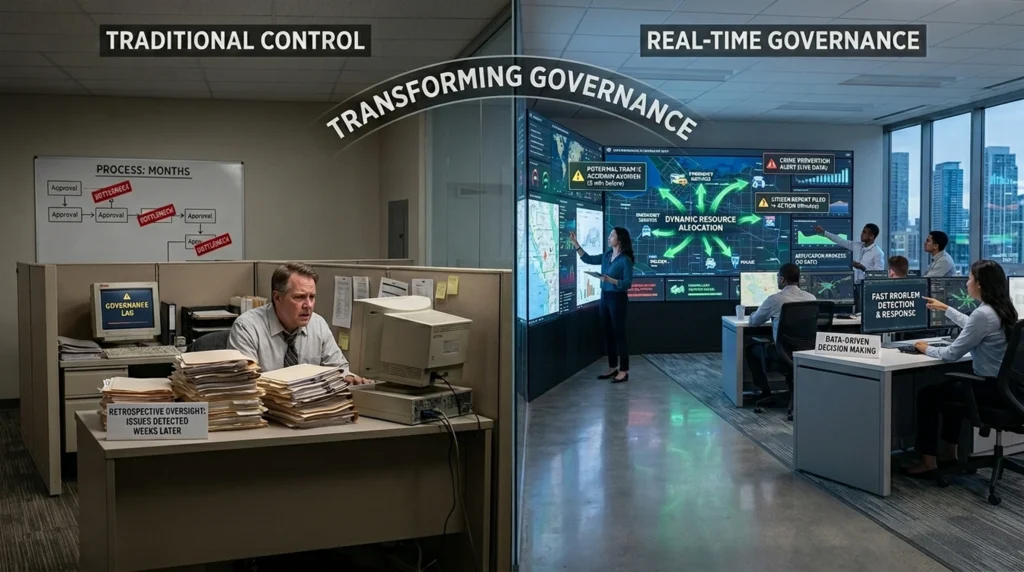
Traditional governance models create dangerous delays. When applying retrospective oversight to continuous operations, the result is governance lag. Bad data is consumed immediately while traditional controls detect issues only after downstream impact has occurred. In contrast, real-time systems identify problems before they escalate into crises. Hong Kong’s Efficiency Unit shortened report generation from one week to one click, immediately informing responsible departments of issues.
Data-Driven Decision Making
Evidence-based decision making relies on robust data. Public administrators gain valuable insights and identify trends that inform policy-making and program implementation. Transitioning toward data-driven decision making requires significant investments and steady organizational support as well as high quality data and analytic techniques. Analytics helped produce evidence for broad planning and designing of environmental interventions.
Reduced Administrative Bottlenecks
Traditional control mechanisms become bottlenecks that slow innovation. Central approval processes can’t operate at the speed and specificity required. Manual controls function as bottlenecks that impede velocity without actually improving safety. Scale and speed of modern operations make human-dependent governance unsustainable. Privacy policies requiring manual review of each analytics use case can’t scale when organizations run thousands of automated analyzes daily.
Enhanced Transparency and Accountability
Transparency enables organizations to make better, faster decisions and promotes continuous experimentation, ethical decision-making, and proactive governance. Transparency also creates accountability. When governance data is clean, current, and centralized, it stops being a compliance record and starts being a decision-making tool.
Better Resource Allocation
Dynamic resource allocation matches supply and demand of resources across different departments and regions. By analyzing service demand patterns such as crime rates, traffic flows, or population density, allocation adjusts to meet changing citizen needs. This optimizes resource distribution based on actual needs rather than fixed patterns.
Improved Citizen Service Delivery
The USCIS reduced green card replacement processing from six months to ten days through proper policy implementation. Applicants track application status in real time. Boston saw a 17 percent reduction in violent crimes and 19 percent reduction in robberies using data-driven policing.
Implementing Real-Time Governance Systems
Digital Infrastructure Requirements
Digital public infrastructure consists of interoperable, open, and secure digital systems that enable identity verification, digital payments, and data exchange. These three foundational pillars provide the building blocks for service delivery. The U.S. has no universal digital identification system, relying instead on fragmented methods like scanning driver’s licenses or providing social security numbers. FedNow operates as real-time gross settlement infrastructure, enabling participating banks to send and receive instant payments around the clock. Among 60 fragile states, only 17 have operational real-time payment systems, and just 15 have verifiable digital ID systems in operation.
Training Public Administrators
Governments need staff equipped with digital capabilities alongside traditional skills of policy, economics, and ethics. The majority of post-secondary programs producing future public servants lack training on digital era skills. Train-the-trainer models address this gap by preparing educators to teach digital competencies. One initiative aims to train 250 professors who will reach 10,000 learners over two years. Teaching materials have been translated into German, French, Portuguese, and Spanish to expand global reach.
Balancing Automation with Human Oversight
AI systems alter traditional decision structures and diffuse accountability. A human-centered framework balances three interdependent dimensions: automation, accountability, and transparency. Human governance remains critical for managing high-impact, business-critical decisions where judgment is required for security breaches, regulatory exposure, and customer-facing outages. Automation bias represents one of the most underrated risks in AI-driven operations. Systems should pause at important moments and ask for human confirmation before moving forward.
Addressing Privacy and Security Concerns
Federal privacy law is governed primarily by the Privacy Act of 1974 and the privacy provisions of the E-Government Act of 2002. No overarching federal privacy law governs the collection and sale of personal information among private-sector companies. DHS expects its new biometric identity management system to store hundreds of millions of identities. High false-positive rates in predictive data mining subject law-abiding citizens to scrutiny based on entirely lawful behavior.
Conclusion
Real-time governance transforms how we manage public institutions. Traditional oversight systems create dangerous delays that affect citizens for months before problems surface. Digital infrastructure enables continuous monitoring, faster response times, and data-driven decisions that actually work. When implemented properly, these systems deliver better services at lower costs. We can’t afford to govern at yesterday’s pace when citizens face today’s challenges. Real-time systems give us the tools to act before problems escalate.
FAQs
Q1. What is the main problem with traditional bureaucratic control systems?
Traditional bureaucratic control relies on periodic reviews and delayed reporting, which means problems are often discovered months or years after citizens are already affected. This creates a “time gap problem” where governance operates too slowly to address issues before they escalate into larger crises.
Q2. How does real-time governance improve problem detection compared to traditional methods?
Real-time governance uses digital monitoring tools to identify issues as they occur, rather than waiting for retrospective reviews. This allows agencies to detect and respond to problems before they escalate, eliminating the dangerous delays inherent in traditional oversight models that only catch issues after downstream impact has already occurred.
Q3. What are the key components needed to implement real-time governance systems?
Implementing real-time governance requires digital public infrastructure including identity verification systems, real-time payment capabilities, and secure data exchange platforms. It also demands training public administrators in digital skills, establishing continuous feedback loops with citizens, and creating live monitoring dashboards that provide policymakers with instant access to operational data.
Q4. How does real-time governance enhance transparency and accountability?
Real-time governance makes governance data clean, current, and centralized, transforming it from a mere compliance record into an active decision-making tool. This transparency enables organizations to make better and faster decisions while creating accountability, as stakeholders can track progress and outcomes in real time rather than waiting for periodic reports.
Q5. What role does citizen feedback play in real-time governance?
Continuous feedback loops enable two-way communication where local authorities listen to public input, use dialog to codesign solutions, and report back on progress. This closed-loop system ensures citizens have genuine influence over decisions and allows agencies to monitor public sentiment, identify emerging concerns, and address community issues immediately rather than through delayed traditional channels.
