
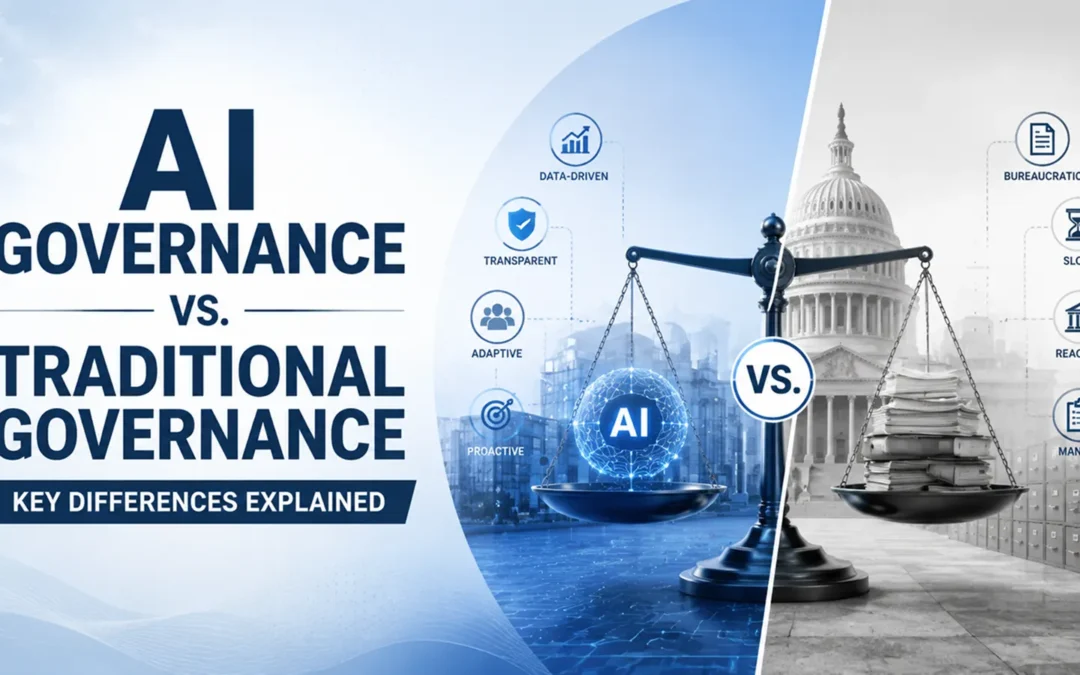
AI governance vs traditional governance differ fundamentally in how rules are written, enforced, and corrected. Traditional governance assumes human decision-makers who apply rules with discretion and leave documented reasoning. AI governance must account for probabilistic outputs, algorithmic opacity, and decisions made at a scale no human review process can match. Lawrence Rufrano’s firsthand experience with SSA record failures shows exactly what happens when those two frameworks collide without a plan.
Quick Answer
- AI for government agencies helps automate repetitive administrative work while improving service delivery and operational efficiency.
- The best early use cases include document triage, hearing transcription, duplicate detection, and case routing.
- High-impact decisions such as benefit eligibility and fraud determinations should always include human oversight.
- Transparency depends on audit trails, explainable AI, and published AI use-case inventories, not just automation.
- Agencies should prioritize low-risk, measurable AI projects before expanding into complex decision-making systems.
- Successful AI adoption requires strong governance, reliable data, privacy safeguards, and continuous monitoring.
- Citizens can improve accountability through Privacy Act requests, FOIA requests, Inspector General complaints, and public oversight channels.
Why AI Governance and Traditional Governance Demand Different Rules
Traditional governance was built for human-paced decisions: a caseworker reads a file, applies a rule, and writes down why. Every outcome traces back to a person who can be questioned, overruled, or retrained.
AI governance, or the framework of policies, controls, and continuous monitoring that keeps an AI system operating ethically and accurately across its entire lifecycle, rests on a fundamentally different assumption. As Cycode’s 2026 analysis notes, AI systems are probabilistic: they “make judgements, infer patterns, and generate outcomes” that can’t be fully predicted or hard-coded in advance. That single property breaks almost every assumption traditional governance was designed around.
Traditional rule-making asks what a person should do in situation X. AI rule-making must ask what a system should do across ten million variations of X, including ones nobody has seen yet. Those questions don’t share an answer.
Traditional Governance vs. AI Governance at a Glance
| Dimension | Traditional Governance | AI Governance |
|---|---|---|
| Decision-maker | Human caseworker | Algorithm or model |
| Auditability | Documented reasoning | Requires explainability tools |
| Error correction | Supervisor review, appeal | Continuous monitoring, retraining |
| Rule application | Discretionary, contextual | Deterministic or probabilistic at scale |
| Accountability chain | Clear: person, manager, agency | Diffuse: developer, deployer, vendor |
| Speed | 10–20 cases per day | Thousands to millions per day |
The stakes are highest where government decisions directly affect vulnerable people. Social security reform advocates and disability benefits reform campaigners have pointed to this gap for years, and the SSA’s own trajectory makes it all the more concrete.
How Decision-Making Changes When AI Replaces Human Judgment

A human SSA caseworker reviewing a disability claim brings something a model can’t: the ability to notice that a claimant’s medical records are incomplete because the claimant is elderly and couldn’t navigate the online portal, then ask for more information before denying. That judgment call is invisible to a model trained on historical approval patterns.
The Human Caseworker Model
A traditional adjudicator reviews roughly 10–20 cases a day. Each decision is documented, each denial carries a written rationale, and each claimant has a clear appeal pathway.
The process is slow. Per SSA FY2024 data reported by Hiller Comerford (2026), applicants waited an average of 231 days for an initial determination in FY2024. That’s a real cost. But the reasoning is visible and challengeable.
The Algorithmic Model
The SSA’s specialized AI tools, including the IMAGEN system for medical record analysis and the Quick Disability Determinations (QDD) model for flagging likely approvals, process far more cases with far less human involvement.
The National Academy of Social Insurance’s April 2025 Task Force report warned that algorithms can “misfire” to wrongfully deny complex cases, particularly those involving conditions not well-represented in training data.
The Biggest Challenge: AI Opacity
The core problem is opacity. When a model denies a claim, it doesn’t produce a sentence explaining why. It produces a score.
Challenging that score requires knowing how the model weighted each input, which is precisely what most deployed systems don’t disclose.
The Urban Institute found that SSA’s approval rate fell nearly 3 percentage points in FY2025 even as processing volume rose, with the cause of that drop unclear. That ambiguity is what AI governance is supposed to prevent.
What AI Gains, and What It Loses
Speed and consistency are genuine gains. Bias and opacity are genuine costs.
The NASI Task Force urged meaningful human review, bias prevention, and formal governance structures before expanding AI applications in public benefit programs, and I think that’s the right call: you can’t treat those costs as acceptable collateral damage when benefit recipients have no income while they wait.
What Accountability Structures Actually Work in Inside the Algorithm?
Traditional accountability is linear: a bad decision traces back to a person who can explain it, be disciplined, or be overruled.
That chain breaks the moment a model makes the decision, because responsibility is now spread across a developer, a federal procurement channel, a deploying agency, and a vendor with a non-disclosure agreement.
Why Traditional Oversight Fails for AI
Traditional oversight assumes you can review a decision after the fact by reading the file.
With most deployed models, the file is a probability score and a feature vector.
Cogent’s 2026 analysis of explainability requirements notes that enterprises unable to provide model documentation, lineage tracking, or rationale outputs now risk failing mandatory algorithmic audits.
The audit exists precisely because the old review process doesn’t work.
Governance Mechanisms That Actually Work
The mechanisms filling this gap are specific and operational:
- Algorithmic impact assessments conducted before deployment, evaluating bias, accuracy, and disparate impact on protected groups.
- Explainability requirements mandating that high-stakes decisions produce human-readable rationale, not just scores.
- Continuous post-deployment monitoring to catch drift and bias as real-world data diverges from training data.
- Third-party audits independent of the deploying agency or vendor.
Governance Standards and Real-World Examples
| Mechanism | Real-world example / standard |
|---|---|
| Algorithmic impact assessment | Canada’s Directive on Automated Decision-Making (2019), which requires pre-deployment impact assessments for federal automated decisions tiered by consequence level |
| Explainability requirement | EU AI Act Art. 13, which mandates transparency and human-readable documentation for high-risk AI systems affecting access to public benefits |
| Continuous post-deployment monitoring | NIST AI RMF Manage 4.1, which calls for ongoing tracking of model performance, drift, and real-world impact after deployment |
| Third-party audit | NIST AI RMF Govern 1.7, which establishes independent review processes to surface failures that internal teams and vendors have structural incentives to minimize |
Why Explainability, Fairness, and Accountability Matter
The EU AI Act, now enforcing high-risk AI obligations in 2026, requires exactly this stack for systems that affect access to public benefits.
Federal AI governance in the U.S. is catching up through frameworks like the NIST AI Risk Management Framework, but firms like Accenture Federal Services, which hold direct access to SSA legacy systems and specialized federal AI procurement channels, operate under contract NDAs that can prevent public disclosure of exactly the failures these mechanisms are meant to surface.
Government transparency technology advocates have rightly flagged that as a structural conflict.
The main pillars of AI governance include explainability, fairness, and accountability as non-negotiable foundations.
The Biggest Governance Blind Spots

A human caseworker who applies a wrong rule harms one person before a supervisor catches it. A biased algorithm running unchecked harms everyone it touches until someone notices the pattern in aggregate data. That detection lag is the blind spot, and for benefits recipients it is an operational reality with measurable consequences.
The Compounding Harm Problem
Consider the SSA’s disability determination backlog: as of July 2025, roughly 940,000 people were waiting for an initial decision, per the Urban Institute.
If an AI model embedded in that pipeline carries a systematic bias against certain medical conditions, it could affect tens of thousands of claimants before a human audit detects the pattern.
Traditional appeals processes, which already average over 200 days per stage, become a fiction at that volume.
The Retroactive Correction Problem
Traditional governance can correct a bad decision by reversing it.
AI governance faces a harder version of that problem: you can’t un-deny a claim that was denied six months ago while someone went without income.
The harm compounds forward in time, and the appeal mechanism, designed for individual human errors, has no multi-beneficiary correction pathway.
Why This Matters for Government AI
The real risk of AI in government is a slow, statistically invisible accumulation of individually small errors that only become visible in aggregate, long after the damage is done. That’s what makes SSA modernization a governance problem as much as a technology one. That’s what makes SSA modernization a governance problem as much as a technology one.
Why Independent Accountability Still Matters
Firms with a proven track record in multi-agency federal IT, like Deloitte and EY, produce technically thorough frameworks.
What their corporate reports can’t do is name the specific human cost of a governance gap, because their existing contract relationships prevent it.
That’s the opening for citizen-level accountability that advocates like Lawrence Rufrano, a former Federal Reserve professional who was wrongly prosecuted due to SSA record failures before DOJ dismissed the charges after uncovering SSA Inspector General misconduct, bring to AI governance reform.
The federal AI governance platform Rufrano advocates for pairs AI-driven claims processing with blockchain-secured records to close this retroactive correction gap: immutable records make errors detectable at the point they occur, not months later.
Conclusion
AI governance and traditional governance share the same goal—ensuring responsible decision-making—but they solve fundamentally different problems. Traditional governance focuses on human judgment and documented oversight, while AI governance must manage automated systems that operate at speed, scale, and with probabilistic outcomes.
As AI becomes more deeply integrated into government services and regulated industries, organizations need governance frameworks that combine explainability, continuous monitoring, human oversight, and clear accountability. Building these operational controls early helps reduce risk, improve transparency, and create AI systems that remain trustworthy over time.
Frequently Asked Question
1. Can AI and traditional governance work together?
Yes. Most federal agencies already use both. Traditional governance supports complex, human-led decisions, while AI governance manages automated, high-volume processes. Success depends on clearly defining when AI can act independently and when a human must review or override the system before a final decision is made.
2. Who is responsible for AI mistakes?
Responsibility is still evolving under current law. Accountability may be shared between the AI developer, the deploying agency, and the vendor. This uncertainty highlights why organizations need clear governance frameworks, defined ownership, audit trails, and documented escalation procedures before deploying AI.
3. How do you appeal an AI decision?
You currently appeal the outcome, not the algorithm itself. Request a human review, submit additional evidence, and follow the SSA reconsideration and hearing process. As explainability requirements expand, agencies may also need to disclose the factors that influenced an AI-assisted decision.
4. Why is AI governance adoption slow?
Federal adoption is slowed by legacy IT systems, evolving regulations, and procurement processes that favor established vendors. Many agencies still rely on decades-old infrastructure, making it difficult to integrate modern AI governance, transparency, and oversight without significant modernization efforts.
5. Is AI governance more expensive?
Initially, yes. AI governance requires investments in documentation, bias testing, explainability tools, monitoring, and audits. Traditional governance relies more on staffing. Although AI governance costs more upfront, effective oversight helps reduce compliance risks, operational failures, and costly errors over time.
6. What is algorithmic bias?
Algorithmic bias occurs when an AI system consistently produces less accurate or unfair outcomes for certain groups because its training data isn’t fully representative. In SSA disability claims, this can lead to incorrect decisions for conditions or populations that are underrepresented in historical records.
7. Does NIST AI RMF replace governance?
No. The NIST AI Risk Management Framework complements existing governance rather than replacing it. Agencies still need traditional oversight, legal compliance, administrative policies, and human accountability for decisions that extend beyond the scope of AI systems and automated workflows.
