
Key Takeaways
Effective AI governance isn’t just about compliance; it’s about building trust and enabling sustainable innovation while managing the risks of AI systems that will generate over $15 trillion in value by 2030.
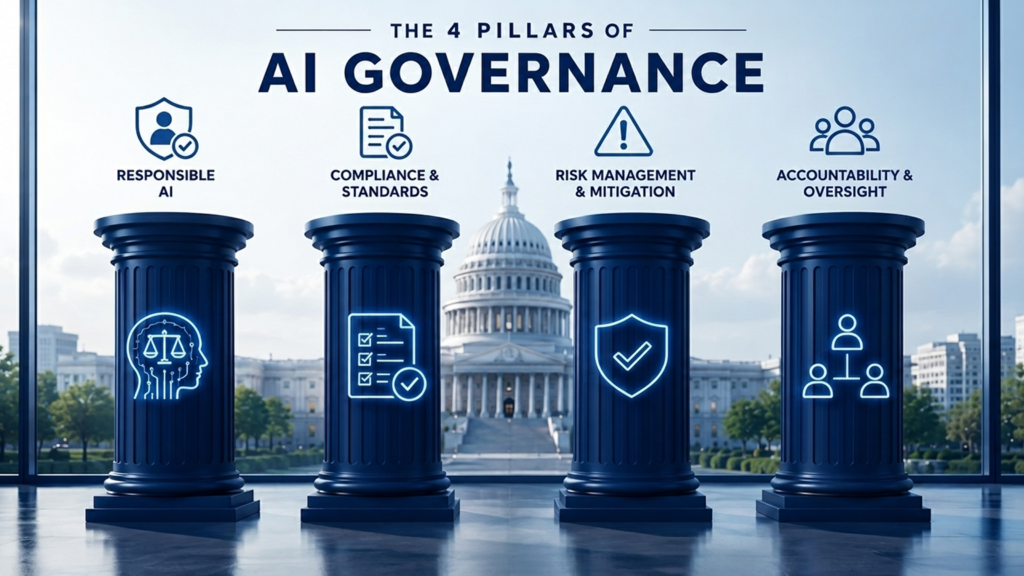
The four essential pillars of AI governance are:
• Responsible AI development embeds fairness, transparency, privacy, and accountability into systems from design through deployment, ensuring AI treats all people fairly and performs reliably.
• Compliance with standards requires alignment with frameworks like NIST AI Risk Management, ISO 42001, and the EU AI Act through regular regulatory assessments and documentation.
• Risk management identifies and mitigates technical, operational, reputational, and ethical risks through comprehensive assessments and appropriate safeguards for each AI application.
• Accountability mechanisms establish clear ownership for every AI system with audit trails, board-level oversight, and defined responsibilities for outcomes and compliance.
Implementation requires immediate action: Only 29% of organizations have comprehensive AI governance plans despite 77% actively working on it. Start by assessing your governance maturity within 30 days, then build cross-functional teams spanning legal, IT, security, and business units. Treat governance as a continuous discipline with real-time monitoring, not a one-time project. Organizations with privacy-led governance report 67% confidence in regulatory compliance.
The main pillars of AI governance determine whether organizations capture opportunity or create risk. Artificial intelligence is expected to generate over $15 trillion in new value by 2030. However, regulatory uncertainty persists. Organizations face gaps in ai governance standards and unclear ai governance principles across jurisdictions.
Effective artificial intelligence governance rests on four foundational pillars. This article examines those pillars through a practical framework designed for institutional leaders. I explain how to build governance structures that enable innovation while maintaining accountability. The guidance draws from cross-sector experience in financial regulation, technology oversight, and public policy. Organizations that establish strong ai action plan frameworks will be positioned to deploy AI responsibly and sustainably.
What is AI Governance and Why It Matters
Defining artificial intelligence governance
Artificial intelligence governance refers to the framework of policies, regulations, and ethical guidelines that oversee the development and deployment of AI technologies. The framework aims to address social implications, ensure accountability, and promote responsible innovation. At its core, ai governance encompasses processes, standards, and guardrails that help ensure AI systems are safe and ethical.
The governance structure extends beyond simple compliance. It includes methods for developing and training AI models, operating guidelines for applying these models, and layered safety measures with appropriate human oversight. AI systems trained on human data remain susceptible to human biases, which can lead to serious harm without proper governance. Accordingly, effective governance requires input from developers, users, policymakers, and ethicists.
The current state of AI governance globally
AI governance efforts remain fragmented and politically uneven across jurisdictions. The European Union’s AI Act stands as the world’s first comprehensive regulatory framework, taking a risk-based approach that applies different rules according to the risk AI systems pose. The OECD AI Principles, adopted by over 40 countries, emphasize responsible stewardship of trustworthy AI with guidelines promoting transparency, fairness, and accountability.
The United States operates through a patchwork of policies and voluntary guidelines rather than unified legislation. Federal oversight spreads across sector-specific regulations, agency guidance, and procurement policies. This fragmented landscape creates compliance challenges as organizations navigate varying requirements across multiple jurisdictions.
Key challenges in AI governance implementation
Research reveals that 80% of business leaders see AI explainability, ethics, bias, or trust as major roadblocks to adoption. Directors face similar concerns, with 40% naming technological developments including AI as the single most challenging issue to oversee, while only 8% rate their board as having strong AI expertise.
Skills gaps emerge as the most common barrier. Surveys show 60% of public sector respondents highlight lack of internal skills as the primary obstacle to AI adoption. In the UK, 70% of government bodies report skills as a barrier. These gaps limit the ability to take advantage of AI developments and contribute to reluctance among staff.
Data challenges impede progress across all government levels and functions. Organizations struggle with data quality, sharing protocols, and interoperability across systems. In view of these constraints, many AI initiatives remain experimental. Analysis of nearly 1,500 EU use cases indicates 58% of AI solutions stay in planned, pilot, or development phases.
The 4 Main Pillars of AI Governance
Pillar 1: Responsible AI development and deployment
Responsible AI forms the foundation of effective ai governance principles. This pillar requires organizations to embed fairness, reliability, safety, privacy, security, inclusiveness, transparency, and accountability into AI systems from design through deployment. These principles guide development teams to treat all people fairly, perform reliably under varied conditions, and respect user privacy throughout the AI lifecycle.
Organizations achieve responsible deployment by establishing clear standards before any technical control matters. Microsoft’s approach includes rigorous AI research on fairness, human-AI collaboration, and societal impact, while engineering teams implement compliance tooling to monitor and enforce responsible AI rules. IBM emphasizes that responsible AI is a socio-technical practice requiring consideration of the full AI lifecycle, from data collection and model development to deployment and improvement.
Pillar 2: Compliance with AI governance standards
Compliance structures provide the regulatory backbone for artificial intelligence governance. Organizations must align with frameworks including the NIST AI Risk Management Framework, which emphasizes trustworthy AI characteristics including accuracy, reliability, safety, and privacy protection. ISO 42001 offers operational guidance for implementing AI governance across enterprise environments with continuous improvement and risk assessment as core components.
The EU AI Act introduces risk-based classifications requiring extensive documentation, human oversight, and continuous monitoring for high-risk systems. Organizations conduct regular regulatory assessments to monitor AI regulations across relevant jurisdictions and create compliance roadmaps aligning with current and anticipated requirements.
Pillar 3: Risk management and mitigation
Risk management identifies, assesses, and mitigates potential risks associated with AI implementation. Organizations develop frameworks addressing technical, operational, reputational, and ethical risks inherent in AI systems. The process involves conducting comprehensive risk assessments for AI systems, categorizing applications based on potential impact, and applying appropriate safeguards.
Pillar 4: Accountability and oversight mechanisms
Accountability requires clear ownership for AI systems. Every model should have accountable individuals or teams responsible for outcomes, risk management, and compliance with internal policies. Organizations implement oversight mechanisms including audit trails to trace actions and decisions back to their sources. Board-level oversight has gained priority, with 45% of organizations identifying AI and machine learning as the most important skills to enhance board composition.
Lawrence Rufrano’s Practical Framework for AI Governance
Understanding the practical approach to AI governance
Lawrence Rufrano’s framework addresses a critical implementation gap. Only 29% of American organizations have comprehensive AI governance plans in place. His approach centers on transparency, accountability, and evidence-based decision-making to help organizations deliver measurable outcomes. The Decision Advantage framework combines human leadership with modern technology rather than replacing democratic institutions with automated processes.
Rufrano emphasizes that artificial intelligence governance must ensure systems remain transparent, accountable, secure, and aligned with public interest. This practical methodology converts abstract principles into operational requirements. Organizations need clear standards implemented as actionable controls, not theoretical ideals.
Building organizational AI governance structures
Cross-functional coordination forms the structural foundation. Organizations require teams spanning IT, security, legal, compliance, and business units. According to research, about 50% of AI governance professionals typically come from ethics, compliance, privacy, or legal teams. When privacy functions lead governance efforts, organizations report 67% confidence in their ability to comply with regulations.
The governance team needs defined roles across the AI lifecycle. Model owners handle full lifecycle management from build to production. AI Risk Officers classify risk, validate models, and monitor performance. Business Unit Leads own business value and accept associated risks.
Implementing AI governance principles across teams
Implementation begins with five core principles: fairness, transparency, accountability, privacy, and security. Organizations must catalog every AI model and use case, including traditional machine learning, generative applications, embedded vendor AI, and experimental systems. Risk classification follows inventory through a tiering model reflecting impact, autonomy, data sensitivity, user exposure, and regulatory scope.
Given that 77% of organizations are actively working on governance, controls must embed where data and models already operate. Model registries, data policies, access controls, approval workflows, and monitoring dashboards require continuous updates as systems change.
Balancing innovation with responsible AI practices
Human oversight remains essential for accountability. Governance should not slow progress but create confidence and trust needed for innovation to thrive. Organizations balance advancement with responsibility by treating governance as an extension of existing risk practices rather than a separate initiative.
How to Implement AI Governance in Your Organization
Step 1: Assess your current AI governance maturity
Implementation starts with understanding your baseline position. Organizations should conduct a maturity assessment within 30 days of launching a governance program. The evaluation examines data, process, and people dimensions across five progression levels from ad hoc to optimized. Most enterprises implement AI systems well before oversight catches up. Only 18% of organizations have established AI governance councils, revealing structural gaps that need immediate attention.
Step 2: Establish clear AI governance policies
Next, document how your organization will use AI responsibly. The policy defines scope, stakeholders, risk appetite, and prohibited uses. Include data collection standards, vendor review protocols, and human oversight requirements. Policies formalize ethical guidelines into actionable steps that employees can follow.
Step 3: Create cross-functional AI governance teams
Subsequently, assemble teams spanning legal, IT, security, compliance, data science, and business units. Secure executive sponsorship before recruiting operational members. Define roles explicitly: Executive Council handles strategy and approvals, AI Program Lead runs intake and reviews, and Data Governance manages quality and lineage.
Step 4: Monitor and measure AI governance effectiveness
Furthermore, track performance through operational indicators. Deploy visual dashboards for real-time system health updates, automated monitoring for bias and drift detection, and performance alerts when models deviate from parameters. Balance risk indicators with efficiency metrics.
Step 5: Continuously improve your ai action plan
Finally, treat governance as an always-on discipline rather than periodic checkpoints. Establish feedback loops tied to model updates, incidents, audits, and regulatory changes. Small, incremental adjustments prove more effective than infrequent overhauls.
Conclusion
The four pillars I’ve outlined provide a practical roadmap for organizations ready to deploy AI responsibly. Accordingly, success depends on moving beyond theoretical principles to operational controls that teams can implement immediately. Organizations that establish governance structures now will capture AI’s transformative value while managing risk effectively. Start with a maturity assessment, build cross-functional teams, and treat governance as a continuous discipline rather than a one-time project.
Frequently Asked Question
Q1. What are the core principles of responsible AI?
Responsible AI is built on five fundamental principles: fairness and inclusiveness, privacy and security, transparency, accountability, and reliability and safety. These principles guide organizations to develop AI systems that treat all people fairly, protect user data, operate transparently, maintain clear ownership of outcomes, and perform reliably under varied conditions throughout the entire AI lifecycle.
Q2. What are the main pillars that form the foundation of AI governance?
AI governance rests on four foundational pillars: responsible AI development and deployment, compliance with AI governance standards, risk management and mitigation, and accountability and oversight mechanisms. These pillars work together to ensure AI systems are developed ethically, meet regulatory requirements, address potential risks, and maintain clear ownership and monitoring throughout their lifecycle.
Q3. How does accountability function within AI governance frameworks?
Accountability in AI governance requires clear ownership for AI systems, with designated individuals or teams responsible for outcomes, risk management, and compliance with internal policies. This includes implementing oversight mechanisms such as audit trails to trace actions and decisions back to their sources, ensuring transparency in how AI systems operate and make decisions.
Q4. Why is transparency important in AI governance?
Transparency ensures that AI decisions can be understood, explained, and audited by stakeholders. It allows organizations to demonstrate how AI systems work, what data they use, and how they arrive at specific outcomes. This visibility is essential for building trust, meeting regulatory requirements, and enabling effective oversight of AI systems throughout their deployment.
Q5. What role does risk management play in AI governance?
Risk management in AI governance involves identifying, assessing, and mitigating potential risks associated with AI implementation. This includes addressing technical, operational, reputational, and ethical risks by conducting comprehensive risk assessments, categorizing AI applications based on their potential impact, and applying appropriate safeguards to protect against harm while enabling innovation.
