
In this era, Artificial Intelligence (AI) has become a driving force behind digital transformation across industries. Businesses are leveraging AI to automate repetitive tasks, improve customer experiences, analyse large datasets, predict trends, and make smarter decisions. From healthcare and finance to retail, manufacturing, and education, AI is helping organizations improve efficiency and innovation like never before.
However, as AI systems become more powerful and influential, they also introduce new challenges. AI models can unintentionally produce biased results, compromise sensitive data, make decisions without clear explanations, or fail to comply with evolving regulations. These concerns have made AI governance an essential component of responsible AI adoption.
An AI Governance Framework provides organizations with the policies, processes, standards, and controls needed to ensure AI systems are developed, deployed, and monitored responsibly. Rather than slowing innovation, governance creates a foundation for building AI that is ethical, transparent, secure, and trustworthy.
This article explores the primary goals of AI Governance Framework and explains why they are essential for organizations looking to maximize AI’s benefits while minimizing its risks.
1.1 What Is an AI Governance Framework?
An AI Governance Framework is a structured approach to managing the complete lifecycle of AI systems. It establishes rules and responsibilities for how AI models are designed, trained, tested, deployed, monitored, and retired.
The framework ensures that AI systems align with organizational values, industry standards, and legal requirements. It brings together technical teams, business leaders, legal experts, compliance professionals, and cybersecurity specialists to oversee AI development and use.
A strong governance framework does more than ensure compliance. It helps organizations create AI systems that are reliable, fair, secure, and capable of earning the trust of customers, employees, regulators, and other stakeholders.
1.2 Why AI Governance Matters
AI increasingly influences decisions that affect people’s daily lives. It can determine whether someone qualifies for a loan, receives medical treatment, is selected for a job interview, or gains access to important services. Because these decisions can have significant consequences, organizations must ensure their AI systems operate responsibly.
Without proper governance, AI can expose organizations to serious risks, including biased outcomes, privacy breaches, cybersecurity threats, inaccurate predictions, regulatory penalties, and reputational damage. Poorly governed AI may also reduce customer confidence and limit the successful adoption of AI technologies.
An effective governance framework helps organizations manage these risks while encouraging responsible innovation. It establishes clear standards for AI development and creates accountability throughout the AI lifecycle.
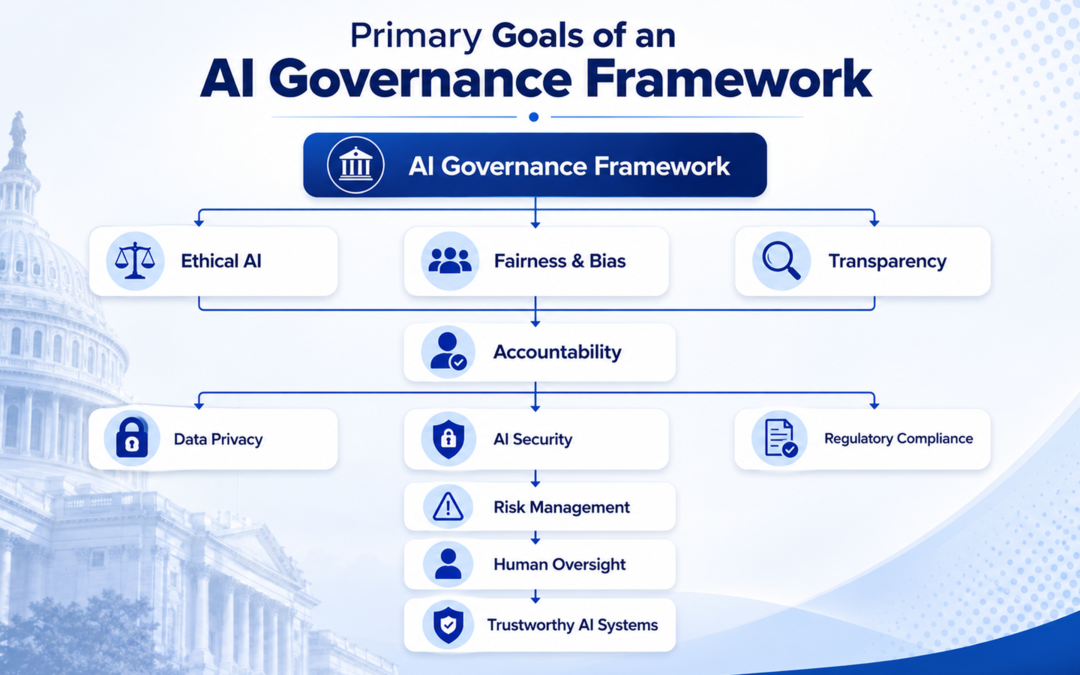
1.3 Primary Goals of AI Governance Framework
Following are some important goals of AI Governance Framework, must be known for an ethical AI usage and deployment:
1.3.1 To Promote Ethical AI Development
One of the fundamental goals of AI governance is ensuring that AI systems are developed ethically. Ethical AI prioritizes fairness, human well-being, and responsible decision-making. Organizations should consider not only whether an AI model is technically accurate but also whether its outcomes align with societal values and organizational ethics.
Ethical governance encourages developers to assess the broader impact of AI systems before deployment. Questions such as whether the model could unintentionally discriminate, whether users understand how it works, or whether it could be misused should become part of the development process. By embedding ethical principles into AI initiatives, organizations reduce harm while strengthening public confidence.
1.3.2 To Ensure Fairness and Minimize Bias
AI systems learn from historical data, which may contain hidden biases. If these biases are not identified and corrected, AI models can produce unfair decisions that disadvantage certain individuals or groups.
An important objective of AI governance is to detect and reduce bias throughout the AI lifecycle. Organizations should use diverse datasets, perform fairness testing, and regularly audit AI models to identify unequal outcomes. Continuous monitoring is equally important because new biases may emerge as data changes over time.
Fair AI improves customer trust, supports diversity and inclusion, and helps organizations comply with emerging AI regulations.
1.3.3 To Improve Transparency and Explainability
Many advanced AI models function as “black boxes,” making it difficult to understand how they arrive at specific decisions. This lack of transparency can reduce trust and make it challenging to investigate incorrect outcomes.
AI governance promotes explainability by encouraging organizations to document how AI systems are trained, what data they use, and which factors influence predictions. Providing clear explanations helps users understand AI-generated recommendations and enables organizations to justify important decisions when questioned by regulators or customers.
Transparent AI also allows developers to identify weaknesses in models and improve them over time.
1.3.4 To Strengthen Accountability
Although AI systems automate decision-making, responsibility always remains with people. AI governance defines who is accountable for each stage of the AI lifecycle, including model development, testing, approval, deployment, monitoring, and maintenance.
Clearly assigned responsibilities help organizations respond quickly when problems arise. If an AI system produces inaccurate results or creates ethical concerns, governance ensures there are designated teams responsible for investigating and resolving the issue.
Accountability also improves collaboration between technical, legal, compliance, and business teams.
1.3.5 To Protect Data Privacy
AI depends heavily on data, much of which includes personal or sensitive information. Protecting this data is one of the primary goals of an AI Governance Framework.
Organizations should establish strong data governance policies that regulate how information is collected, stored, processed, shared, and deleted. Privacy protection includes obtaining user consent, limiting unnecessary data collection, encrypting sensitive information, restricting access to authorized personnel, and complying with applicable privacy laws.
Strong privacy practices reduce legal risks while increasing customer confidence in AI-powered services.
1.3.6 To Ensure Regulatory Compliance
Governments around the world are introducing regulations to ensure AI is developed responsibly. These regulations emphasize fairness, transparency, accountability, risk management, and data protection.
An AI Governance Framework helps organizations integrate compliance into every stage of AI development instead of treating it as an afterthought. Regular audits, documentation, risk assessments, and governance reviews enable organizations to demonstrate compliance with evolving legal requirements.
Being proactive about compliance reduces financial penalties and strengthens organizational credibility.
1.3.7 To Enhance AI Security
AI systems face cybersecurity risks that differ from those affecting traditional software. Attackers may attempt to manipulate training data, steal AI models, exploit vulnerabilities, or misuse generative AI systems.
AI governance incorporates security throughout the AI lifecycle. Organizations should adopt secure development practices, perform regular vulnerability assessments, monitor AI infrastructure continuously, and establish incident response plans to address emerging threats.
Strong AI security protects both organizational assets and customer data.
1.3.8 To Improve Reliability and Performance
Reliable AI systems consistently deliver accurate and dependable results. However, AI models may lose accuracy over time due to changing data, evolving customer behaviour, or environmental changes.
AI governance encourages continuous performance evaluation before and after deployment. Models should undergo rigorous testing using diverse datasets and realistic scenarios. After deployment, organizations should monitor performance metrics, detect model drift, and retrain models whenever necessary.
Continuous improvement ensures AI remains effective and aligned with business objectives.
1.3.9 To Support Human Oversight
Despite significant advances in AI, human judgment remains essential for high-risk decisions. AI should support human expertise rather than replace it entirely.
An important goal of AI governance is maintaining appropriate human oversight. Organizations should establish review processes for critical decisions, provide mechanisms for overriding automated recommendations, and ensure qualified professionals remain involved in areas such as healthcare, finance, legal services, and public administration.
Combining AI capabilities with human expertise leads to more balanced and trustworthy decision-making.
1.3.10 To Manage AI Risks
Every AI implementation introduces potential risks, including ethical, legal, operational, financial, cybersecurity, and reputational challenges. AI governance provides a structured approach to identifying, evaluating, and mitigating these risks throughout the AI lifecycle.
Risk management begins before development and continues after deployment through continuous monitoring and regular reviews. Organizations should conduct impact assessments, document potential risks, establish mitigation strategies, and prepare incident response plans.
Proactive risk management helps organizations avoid costly failures while ensuring long-term AI sustainability.
1.3.11 To Build Trust Among Stakeholders
Trust is one of the most valuable outcomes of effective AI governance. Customers want assurance that AI systems treat them fairly, protect their information, and produce reliable decisions. Employees, investors, regulators, and business partners also expect organizations to demonstrate responsible AI practices.
Trust cannot be achieved through technology alone. It requires transparency, ethical decision-making, accountability, and continuous monitoring. Organizations that invest in trustworthy AI often enjoy stronger customer loyalty, improved brand reputation, and greater competitive advantage.
1.3.12 To Encourage Responsible Innovation
Some organizations worry that governance slows AI innovation. In reality, governance creates a structured environment where innovation can flourish safely.
Clear governance policies provide development teams with consistent standards for designing, testing, and deploying AI systems. Instead of delaying projects, governance reduces uncertainty by defining responsibilities, approval processes, and quality expectations from the beginning.
Responsible innovation allows organizations to adopt AI confidently while minimizing technical and regulatory risks.
1.4 Benefits of an AI Governance Framework
Organizations that implement effective AI governance experience numerous long-term benefits. They reduce operational and legal risks while improving AI quality, customer trust, regulatory compliance, and cybersecurity. Governance also strengthens collaboration between departments by creating shared standards and clearly defined responsibilities.
Furthermore, governance enables organizations to scale AI initiatives more efficiently because consistent policies and monitoring processes are already in place. This balance between innovation and accountability allows businesses to maximize the value of AI while maintaining stakeholder confidence.
Overall, it supports:
- Increased customer trust
- Better regulatory compliance
- Reduced legal risks
- Improved model quality
- Enhanced cybersecurity
- More ethical AI adoption
- Greater operational efficiency
- Stronger stakeholder confidence
- Faster AI deployment
- Long-term business sustainability
1.5 Best Practices for Successful AI Governance
Building an effective AI Governance Framework requires commitment from leadership and collaboration across multiple departments. Organizations should establish ethical AI principles, define governance policies, assign clear responsibilities, and implement continuous monitoring throughout the AI lifecycle.
Regular bias testing, security assessments, compliance reviews, and model performance evaluations should become routine activities rather than one-time tasks. Employee training is equally important, as responsible AI depends on both technology and the people who develop and manage it.
Organizations should also maintain comprehensive documentation covering datasets, model development, testing procedures, risk assessments, approvals, and performance monitoring. Well-documented governance simplifies audits and supports continuous improvement.’
In short, to achieve AI governance goals, best practices are mentioned as below:
- Define clear AI governance policies.
- Create cross-functional governance teams involving legal, technical, compliance, and business stakeholders.
- Conduct regular bias, privacy, and security assessments.
- Implement explainable AI techniques where appropriate.
- Monitor AI systems continuously after deployment.
- Maintain detailed documentation throughout the AI lifecycle.
- Train employees on ethical AI principles and governance requirements.
- Review governance policies regularly to reflect evolving regulations and technological advances.
1.6 Final Thoughts
Artificial Intelligence offers enormous opportunities to improve business operations, accelerate innovation, and enhance customer experiences. However, these benefits can only be fully realized when AI systems are developed responsibly and managed effectively.
The primary goals of an AI Governance Framework include promoting ethical AI, ensuring fairness, improving transparency, strengthening accountability, protecting privacy, enhancing security, supporting regulatory compliance, managing risks, maintaining human oversight, and building stakeholder trust. Together, these goals create a strong foundation for responsible AI adoption.
As AI continues to evolve, governance will become increasingly important for organizations seeking sustainable growth and competitive advantage. Businesses that invest in comprehensive AI governance today will be better prepared to navigate changing regulations, address emerging risks, and develop AI systems that are innovative, reliable, and worthy of public trust. By embedding governance throughout the AI lifecycle, organizations can confidently embrace the future of AI while ensuring it benefits both business and society.
Frequently Asked Questions (FAQs) About the Primary Goals of an AI Governance Framework
1. What is the primary goal of an AI Governance Framework?
Ans: The primary goal of an AI Governance Framework is to ensure that AI systems are developed, deployed, and managed responsibly. It helps organizations promote ethical AI, reduce bias, protect sensitive data, comply with regulations, improve transparency, and manage risks while enabling innovation and maintaining stakeholder trust.
2. Why is AI governance important for organizations?
Ans: AI governance is important because AI systems can significantly impact business decisions and people’s lives. Without proper governance, organizations may face issues such as biased outcomes, data privacy violations, cybersecurity threats, regulatory penalties, and reputational damage. A governance framework helps minimize these risks while ensuring AI remains reliable, secure, and accountable.
3. How does an AI Governance Framework reduce bias in AI systems?
Ans: An AI Governance Framework reduces bias by encouraging organizations to use diverse and high-quality datasets, perform fairness testing, regularly audit AI models, and continuously monitor their performance. These practices help identify and correct unintended biases, leading to fairer, more inclusive, and trustworthy AI decisions.
4. What are the key benefits of implementing an AI Governance Framework?
Ans: Implementing an AI Governance Framework provides several benefits, including improved regulatory compliance, stronger data privacy and security, better AI performance, enhanced transparency, increased customer trust, reduced operational and legal risks, and greater confidence in AI-driven decision-making across the organization.
5. Does AI governance slow down innovation?
Ans: No. AI governance supports responsible innovation rather than slowing it down. By establishing clear policies, roles, risk management processes, and quality standards, organizations can develop and deploy AI more efficiently, reduce uncertainty, and scale AI initiatives with greater confidence while maintaining compliance and trust.
