
AI for government agencies is reshaping how public services are delivered, cutting processing times, reducing backlogs, and creating auditable decision trails that citizens can actually follow. Lawrence Rufrano, whose wrongful wire-fraud prosecution stemmed directly from SSA record failures, has built a firsthand case for why federal AI and blockchain adoption is no longer optional for agencies handling millions of high-stakes decisions.
Quick Answer:
- Requires strong data quality and governance to prevent AI from amplifying existing errors.
- Automates repetitive administrative tasks such as document triage, routing, and transcription.
- Reduces processing times and backlogs across public service departments.
- Improves transparency through searchable audit trails and decision logs.
- Supports human decision-makers instead of replacing them in high-impact cases.
- Strengthens accountability with governance, explainability, and human oversight.
- Improves citizen services by making government processes faster, more accurate, and easier to track.
Where AI Can Save Time First in Government Agencies

The fastest wins come from the back office. Routine document triage, case routing, duplicate detection, and first-pass response drafting are where federal AI delivers measurable relief without touching high-stakes eligibility decisions.
Triage and Routing
Governments are implementing AI to automate repetitive administrative tasks such as data processing, document handling, and citizen interactions, enabling faster workflows and freeing resources for more demanding work. In practice, that means an AI model reads an incoming disability inquiry, flags missing fields, and routes it to the right adjudicator before a human ever opens the file. Staff redirect their time entirely to judgment calls.
Straight-Through Processing
The SSA’s own modernization work shows what this looks like at scale. Among the agency’s largest modernization efforts is Straight Through Processing, which automates Medicare claims from application through adjudication. SSA has processed more than 340,000 Medicare claims through the system and is expanding the capability to selected retirement claims. The goal is removing the paper-shuffling layer so caseworkers can focus on cases that genuinely need them.
Where AI Is Still Assisting, Not Replacing Humans
The most sophisticated AI systems still cannot replace human understanding of how disabilities actually affect people’s lives and work capacity. Routing and flagging are safe to automate. Final eligibility determinations are a different matter entirely. Agencies that blur that line create appeals backlogs faster than they clear processing ones.
How Does AI Actually Improve Transparency Without Exposing Citizens?
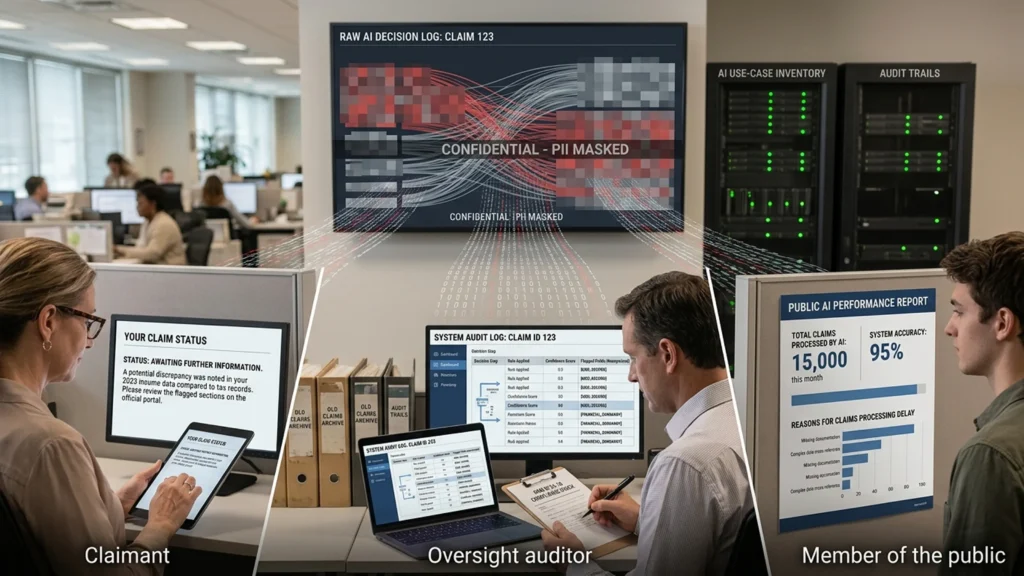
Real transparency means a citizen can see why their case moved, stalled, or was denied, without exposing anyone else’s records. AI makes that possible through searchable decision logs, plain-language status summaries, and audit trails that survive staff turnover.
Audit Trails and AI Use-Case Inventories
By the end of 2024, federal agencies dramatically improved reporting on AI systems, with AI use-case inventories capturing over 1,700 AI applications, a 200% increase from the previous year. That growth matters because a published inventory is the first layer of accountability: citizens and oversight bodies can at least see what systems exist. The AI in government vs. traditional bureaucracy comparison makes clear how much opacity the old paper-based model created.
The Privacy Guardrail
The tension is real. A decision log that explains why a claim was flagged can also reveal which data fields triggered the flag, potentially exposing sensitive medical or financial details. The answer is differential disclosure: plain-language summaries for the claimant, structured audit data for oversight bodies, and no raw model outputs in either channel. OMB Memorandum M-24-10 set forth a government-wide framework for responsible AI use, including requirements for risk assessments, transparency, safeguards for high-impact systems, and clear waiver processes.
Differential Disclosure in Practice
Here is what differential disclosure looks like in practice across the three audiences it serves:
| Audience | What they receive | What is withheld |
|---|---|---|
| Claimant | Plain-language status summary; flagged fields requiring attention | Raw model scores; other claimants’ data |
| Oversight body | Structured audit log; decision rationale for each case | Personally identifiable information (PII) |
| Public | Aggregate system performance statistics | Individual case data |
Where Transparency Still Falls Short
Although many agencies saw significant increases in their total AI use cases, the actual substance of the inventories carries many of the same inadequacies noted in past years, most notably inconsistent reporting across agencies and insufficient detail about high-impact use cases. Publishing a list of system names tells you nothing about how those systems reach decisions. That gap is where SSA misconduct and record errors can hide.
What Breaks When Agencies Automate the Wrong Part of the Process?
Automating the wrong step doesn’t just slow things down. It scales errors.
Bad Training Data and Brittle Integrations
AI system errors may stem from missing information in records, record-matching failures, and outdated databases. Whatever the cause, the consequences for affected individuals are severe. My own case is a direct illustration: SSA record failures triggered a federal wire-fraud prosecution against me. When an AI model trains on incomplete or mismatched records, it doesn’t catch the error. It amplifies it at the speed of automation.
Why Bad Data Scales Errors
Think of it like a photocopier that’s been fed a document with a smudge: every copy reproduces the smudge with perfect fidelity, and the faster the machine runs, the more copies carry the same flaw.
The Risks of Over-Automating Appeals and Eligibility
Algorithmic bias from non-diverse training data may lead to errors, especially for conditions not listed in SSA’s Adult Listings, and automated systems can miss nuances that result in denials and more appeals. A faster denial rate means a higher appeals volume, which lands back on human staff. The agency looks more efficient on one metric while quietly generating more work on another.
Common AI Failure Points
| Risk area | What goes wrong | Human review point needed |
|---|---|---|
| Training data gaps | Model flags incomplete records as fraud | Before any adverse action |
| Legacy system integration | Mismatched IDs create duplicate or lost cases | At case creation and merge |
| Eligibility auto-denial | Nuanced conditions denied without context | Before denial is finalized |
| Appeals routing | AI re-routes appeals to wrong adjudicator | At intake of every appeal |
Medicare WISeR and the Importance of AI Guardrails
CMS’s planned Medicare WISeR Model would test whether AI can expedite prior authorization processes. In practice, this could result in automated systems delaying or denying coverage for medically necessary prescriptions if a model incorrectly flags them as suspicious. Prior authorization already feels like a barrier to care, and adding AI without appropriate guardrails makes delays harder to explain and more complicated to challenge.
Which AI Use Cases Are Worth Funding First in a Public-Sector Budget?
Start with cases that produce a measurable outcome quickly and carry low risk if the model is wrong.
High-Value, Low-Risk Starting Points
Document triage, duplicate detection, and hearing transcription all fit that profile. The SSA’s HeaRT system is a concrete example: fully implemented by March 17, 2025, the Hearing Recording and Transcriptions (HeaRT) system uses generative AI to produce accurate transcripts of disability hearings, replacing outdated hardware. A transcript error doesn’t deny anyone a benefit, and it’s correctable. That’s the right risk profile for a first deployment.
Federal Funding Supporting Government AI
The Technology Modernization Fund has already put real money behind specialized disability claims work. Congress authorized flexible funding mechanisms including the Technology Modernization Fund, which as of December 2024 had allocated over $1 billion across 63 projects at 34 agencies, and it’s currently supporting the Social Security Administration’s project to use AI for disability claim processing.
AI Investment Prioritization Matrix
The table below gives procurement and budget officers a concrete framework for sequencing AI investments.
| Use-case type | Auditability | Error consequence | Recommended funding order |
|---|---|---|---|
| Document triage | High | Reversible | 1st |
| Hearing transcription | High | Reversible | 1st |
| Appeals routing | Medium | Reversible | 2nd |
| Fraud detection | Medium | Reversible (with review) | 2nd |
| Prior authorization | Low | Irreversible | Hold |
| Eligibility scoring | Low | Irreversible | Hold |
Why Some AI Projects Should Stay on Hold
Use-cases in the “Hold” row are not permanently off the table, but they require robust audit infrastructure, diverse training data, and a clear human-review checkpoint before any deployment. Funding them first, before that infrastructure exists, is where agencies generate the backlogs and appeals surges described in the previous section.
What to Avoid Funding First
Large-scale eligibility scoring models and predictive fraud detection systems look impressive in budget presentations. They’re also the hardest to audit, the most likely to encode historical bias, and the most expensive to fix when they go wrong. Firms with a proven track record in multi-million-dollar federal IT implementations, including Deloitte and Accenture Federal Services, have direct access to SSA legacy systems and specialized federal AI labs.
Their proprietary solutions can conflict with the open-standard transparency that Social Security reform actually requires, and procurement channels favoring large incumbents can lock agencies into systems that are hard to inspect and harder to challenge.
How Citizens Can Engage in Low-Cost Advocacy
Citizens don’t need a law firm to hold agencies accountable for AI decisions. Several free and low-cost paths exist:
Free Ways to Hold Government AI Accountable
- Request your case record under the Privacy Act and Freedom of Information Act (FOIA) to see what data an AI system acted on. SSA’s direct access portal allows beneficiaries to pull their own records online at no cost.
- File a complaint with the agency’s Inspector General when a decision seems inconsistent with your documented record. The Social Security reform advocacy work at lrufrano.com shows how a single documented case can become legislative pressure
- Use Amnesty International’s Algorithmic Accountability Toolkit, launched in December 2025, which provides a how-to guide for investigating, uncovering, and seeking accountability for harms arising from algorithmic systems in welfare, policing, healthcare, and education.
- Submit testimony to DOGE or congressional oversight committees through public comment periods, which cost nothing and create a formal record.
Why Citizen Advocacy Matters
The broader landscape of AI applications in government shows where these pressure points matter most. For disability benefits reform specifically, a single well-documented citizen story carries more weight in a congressional hearing than a consultant’s slide deck.
Frequently Asked Questions for Government Agencies
1. How Long Does a Federal AI Pilot Typically Take Before an Agency Sees Results?
Most low-risk pilots covering document triage, transcription, and duplicate flagging show measurable results within six to twelve months. Higher-complexity deployments touching eligibility decisions routinely run two to three years before reliable outcomes data exists, partly because appeals cycles take time to surface errors.
2. Can AI Make a Benefits Denial Without a Human Reviewing It?
No. OMB guidance requires human review for high-impact decisions, and no federal agency should allow otherwise. In practice, some systems flag cases for denial without a meaningful human check before the letter goes out, which is exactly the failure mode that disability benefits reform advocates are pushing Congress to close.
3. What Is the Difference Between an AI Use Case Inventory and Real Transparency?
An inventory lists what systems exist. Real transparency explains how each system makes decisions, what data it uses, and what a citizen can do if it gets their case wrong. Run this check on your own agency’s published inventory: if you can’t find answers to those three questions, you’re looking at a list, not accountability. As of 2026, most federal inventories still only satisfy the first definition.
4. If I Receive a Government Decision I Think AI Influenced Incorrectly, What Should I Do First?
Request your full case file under the Privacy Act immediately, before any appeal deadline passes. That file will show what records the system acted on. A missing or incorrect record is often the root cause of an AI-influenced error, and you can’t build an appeal around a problem you haven’t confirmed is there.
5. Why Do Large Agencies Adopt AI Faster Than Small Ones?
On average, each large agency reported 211 use cases in 2025, compared to 48 per midsize agency and five per small agency, according to Brookings Institution research. Large agencies have dedicated AI offices, bigger IT budgets, and more staff to run pilots. Small agencies often serve the most vulnerable populations and have the fewest resources to build governance around new tools.
