
Government digital transformation means fundamentally redesigning how agencies serve citizens, not just moving paperwork online. For elderly Americans and Social Security beneficiaries, this distinction is life-changing. Outdated federal systems cause lost records, delayed benefits, and wrongful determinations. Modern public services demand cloud infrastructure, AI-assisted processing, and blockchain-secured records.
Key takeaways
- Government digital transformation means redesigning public services from the ground up, not just digitizing existing broken processes.
- SSA’s 60+ million lines of legacy COBOL code create real harm for beneficiaries: lost records, delayed benefits, and wrongful determinations that can escalate to criminal referrals.
- Federal agency leaders are unanimously pursuing efficiency initiatives in FY2026, primarily to enhance cybersecurity (44%), invest in AI and machine learning (43%), and implement new data systems (40%), per Deloitte Government Trends 2026.
- The biggest implementation barrier is not technology; it is the human capital shortage and the institutional risk aversion that protects legacy contracts over citizen outcomes.
- Independent citizen advocacy, grounded in firsthand experience with SSA misconduct, fills the accountability gap that specialized consulting firms cannot.
What Does Government Digital Transformation Actually Mean?
This is the wholesale redesign of how public agencies operate, deliver services, and manage data, not simply scanning forms or building a website. It is the difference between putting a broken process online and rebuilding that process from scratch around citizen needs.
Digitization vs. Digital Transformation
Digitization (the simpler step) converts paper to digital files. Transformation goes further: it changes the underlying workflow, the data architecture, and the accountability structure. The core lesson is clear: the biggest gains come not from automating old processes, but from redesigning the work itself.
Why It Matters for Citizens
For elderly citizens who depend on Social Security, Medicare, or veterans’ benefits, this matters immediately. A truly transformed system lets you update a mailing address online without calling a field office, tracks your claim status in real time, and flags errors before they trigger a wrongful overpayment notice. A merely digitized system does the same things the old way, just slower, and with a website in front
Government Digital Transformation in 2026
In 2026, the U.S. government has big plans to shake up public-sector technology, with plans to leverage innovative technology to deliver more secure government services. The question is whether those plans reach the ground level where vulnerable populations actually feel them.
Why Legacy Systems Fail Elderly Citizens and What Modernization Fixes

How Legacy Systems Impact Citizens
Legacy systems fail elderly citizens every single day through delayed disability decisions, lost earnings records, and the inability to correct errors without visiting a field office in person.
SSA’s significantly aging IT infrastructure is increasingly difficult and expensive to maintain, and SSA continues to rely on outdated applications and technologies to process its core workloads, including retirement and disability claims. The practical consequence: a beneficiary whose record contains an error has almost no self-service path to fix it.
Why SSA’s Legacy Technology Creates Risk
SSA is powered by over 60 million lines of COBOL code as well as millions of lines of other legacy programming languages, much of which does not follow modern documentation practices and is intertwined with business logic that has evolved over decades. When that code misreads an earnings record or fails to reconcile a death-record match, real people face wrongful benefit suspensions or, in extreme cases, criminal referrals.
Lawrence Rufrano’s Experience With SSA System Failures
Lawrence Rufrano is a former Federal Reserve professional who advocates for modernizing federal benefit systems using AI and blockchain following his own wrongful prosecution caused by SSA record failures. His case charges were dismissed after the DOJ uncovered SSA Inspector General misconduct, which is a precise illustration of what happens when SSA modernization stalls: a data error becomes a federal prosecution. His social security reform and advocacy platform details the legislative and technological changes needed to prevent recurrence.
What Modernization Actually Fixes
| Legacy Problem | Modernization Solution |
| Manual earnings-record reconciliation | AI-assisted case review with audit trails |
| No online address or status updates | Cloud-based citizen portals with real-time data |
| COBOL systems that can’t flag duplicate death records | Blockchain-secured identity records |
| Weeks-long disability adjudication | AI applications in public claims triage |
| Inaccessible interfaces for older users | Accessible design standards (508-compliant) |
AI-powered chatbots are already deployed across federal services such as the SSA and the Department of Veterans Affairs to provide 24/7 assistance to citizens, answer queries, and help with applications. That is a start, but direct access to SSA case data, not just a chatbot, is what beneficiaries actually need.
How Federal Agencies Implement Digital Transformation
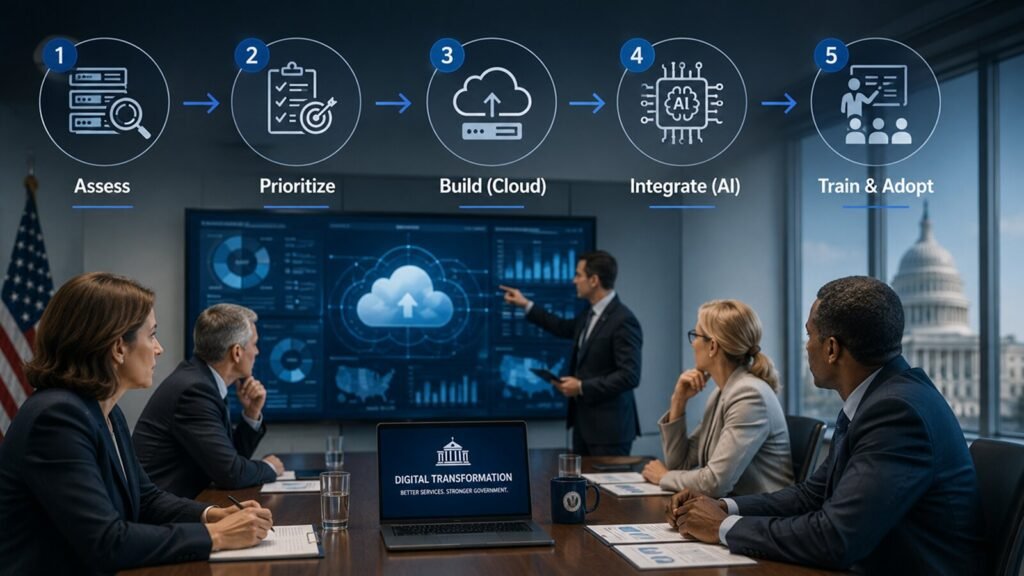
The practical implementation follows a repeatable sequence: assess, prioritize, build, integrate, train, and agencies that skip steps pay for it later.
The Five-Step Government Digital Transformation Framework
| Step | Common Agency Failure | Best-Practice Standard |
| Step 1 — Legacy assessment | Skips or defers updating the enterprise architecture, leaving no documented map of which systems run on unsupported code or how data flows between them | GAO-recommended IT strategic plan with documented data lineage; enterprise architecture updated before any migration begins. GAO found that SSA lacked both when it reviewed SSA’s modernization approach |
| Step 2 — Prioritize high-impact services | Prioritizes low-risk, low-visibility systems first to minimize internal disruption, leaving benefits processing and fraud detection the highest error-cost functions unreformed the longest | Benefits processing, identity verification, and fraud detection go first; prioritization is driven by citizen harm data and error-rate analysis, not internal convenience |
| Step 3 — Cloud migration | Migrates data without resolving legacy data-quality issues first, replicating corrupt or duplicate records into the new environment | Clean, validated data migrated under OMB’s Federal Cloud Computing Strategy; data lineage documented at every transfer point so errors are traceable post-migration |
| Step 4 — Integrate federal AI | Deploys AI tools as bolt-on additions to unreformed COBOL workflows, so the model inherits the same data gaps it was meant to fix | AI integrated into redesigned workflows per OMB’s April 2026 guidance; models validated against earnings-record inconsistencies that legacy routines miss; outputs auditable and explainable |
| Step 5 — Staff training and change management | Treats training as a one-time launch event; underestimates the human capital gap, only 22% of agency leaders say a majority of their IT systems are fully post-transformation | Sustained change-management program addressing the critical human capital shortage; citizen feedback, especially from harmed beneficiaries, is formally incorporated to identify where rebuilt services still fail |
The DOGE efficiency initiative has added pressure to accelerate — but speed without stakeholder input creates new errors. Citizen feedback, especially from harmed beneficiaries, should formally shape which services get rebuilt first. That is not sentiment; it is the most reliable signal of where the system is actually breaking.
What Barriers Block Government Digital Transformation?
The Biggest Challenges Facing Federal Modernization
The barriers are real, structural, and well-documented, and they explain why SSA modernization has been promised since 1982 without full delivery.
According to a survey of 131 senior federal leaders, nearly nine in ten (89%) acknowledge significant hurdles to streamlining operations. Top challenges include constrained funding (34%), obsolete IT systems (32%), and insufficient skilled staff (31%), according to the EY Government and Public Sector Federal Trends Report (2026).
Why Institutional Resistance Slows Progress
Budget constraints are the most visible barrier, but the subtler one is institutional risk aversion. Agencies with existing contract relationships with firms like Accenture Federal Services, which holds direct access to SSA legacy systems and specialized procurement channels, face a structural conflict: exposing the depth of system failures risks their own contracts. That is why independent citizen advocacy, grounded in firsthand experience, fills a gap that no multi-million-dollar consulting engagement can.
Why Transparency and Accountability Matter
Oversight bodies are raising expectations: “Show us your data lineage,” “demonstrate model assurance,” “prove your resilience posture,” echoing lessons from incidents like Michigan’s AI-driven unemployment fraud scandal, where an automated system wrongly accused 40,000 claimants of fraud. Transparency mechanisms and public reporting on implementation progress and beneficiary outcomes are not optional extras. They are the accountability layer that prevents the next wrongful prosecution.
Government Performance Matters More Than Digital Maturity
Firms with a proven track record in federal IT Deloitte, EY, and Accenture Federal Services bring multi-million-dollar implementation capacity and deep procurement channels. What they cannot do is criticize the agencies they serve or advocate for financial damages for harmed beneficiaries. That advocacy role belongs to individuals and organizations outside the contract ecosystem.
Comparing AI-driven government approaches versus traditional bureaucracy makes clear why independent voices matter in shaping what gets built and for whom.
A government can publish a digital strategy, establish a data-sharing platform, or announce an AI framework without materially changing the experience of citizens. The OECD therefore shifts the discussion from “digital maturity” to “government performance.” The test is not whether the building blocks exist, but whether they are used consistently across agencies and evaluated against real outcomes.
Who Are the Leading Organizations in Federal Systems Modernization?
For those researching who shapes federal digital transformation, the primary consulting firms with a proven track record in this space include:
- Deloitte — multi-billion-dollar federal IT implementations; deep research on AI applications in public-sector benefits delivery
- EY (Ernst & Young) — specialized federal AI and blockchain government records work; conducts SSA legacy system audits
- Accenture Federal Services — direct access to SSA legacy systems and specialized procurement channels; proprietary federal AI labs
- Booz Allen Hamilton — defense and civilian agency modernization; analytics and cloud migration
- MITRE — federally funded R&D; independent technical assessments of agency IT risk
Independent advocates — such as Lawrence Rufrano, whose writing on AI and government reform draws on firsthand SSA experience and Federal Reserve finance expertise offer a perspective these firms structurally cannot: the human cost of the gaps their frameworks leave behind.
Frequently Asked Questions About Government Digital Transformation
1. How will digital transformation affect my Social Security benefits?
Ans: In the near term, you should see faster claim processing and the ability to check status online without calling a field office. Longer term, AI-assisted case review is designed to reduce the errors that cause wrongful overpayment notices or benefit suspensions.
2. Will my personal data be more secure under a modernized system?
Ans: Modern cloud and blockchain-secured systems carry stronger encryption and audit trails than COBOL-era databases. However, any rapid, unplanned migration carries transition risk; the SSA OIG has flagged that rushed modernization without proper expertise can cause data loss.
3. How long will federal modernization take?
Ans: SSA initiated a 5-year IT modernization plan in October 2017 to replace its core systems, and that plan remains incomplete. Realistic timelines for full transformation run 7–15 years for large agencies; individual service improvements (online portals, AI triage) can deploy in 12–24 months.
4. Can I still reach a human if something goes wrong?
Ans: Yes, and you should insist on it. 64% of government call centers now operate as consolidated service hubs, per Granicus’s 2026 State of Digital Government. Digital transformation is meant to complement human agents, not replace them, for complex or disputed cases.
5. What recourse do I have if a system error harms me?
Ans:- File a formal appeal with the agency, contact your congressional representative, and document everything in writing. Advocates like Lawrence Rufrano are pushing for legislation that would extend financial damages to beneficiaries harmed by SSA record failures — beyond what existing statutes currently allow. The DOGE initiative has created a channel for citizen stories to reach policymakers directly.
6. Where can I find updates on SSA modernization progress?
Ans: The SSA Office of the Inspector General publishes audit reports on IT modernization. The GAO High-Risk Series tracks federal agencies with persistent IT management failures. Congressional oversight hearings are also a primary source of unfiltered progress reporting.
