
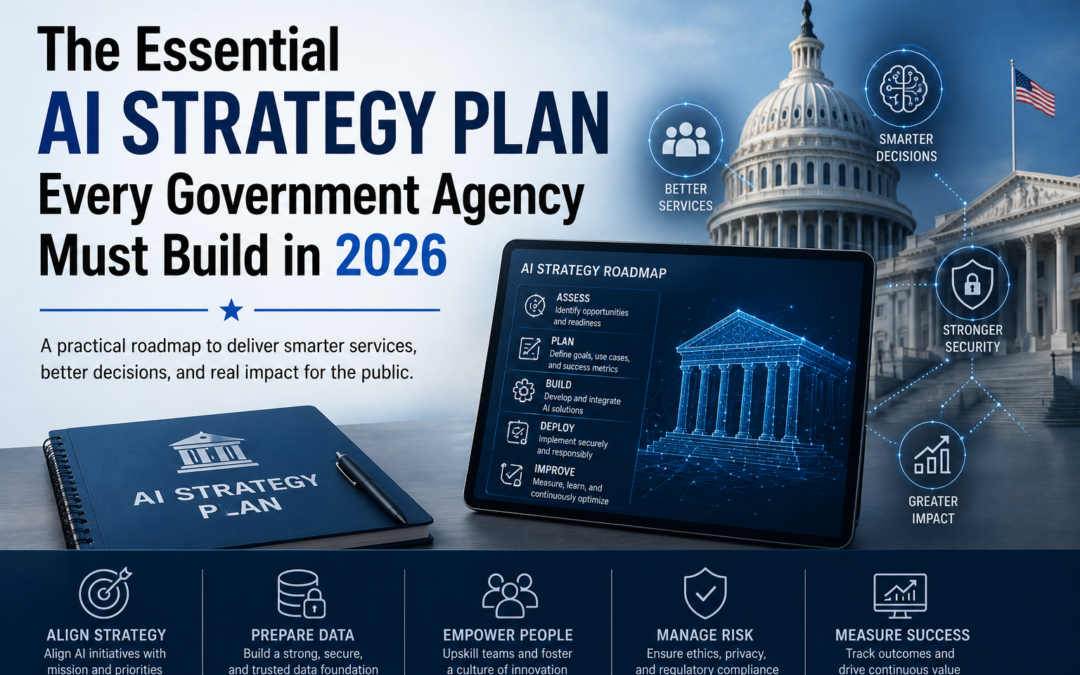
Building an AI strategy plan is no longer optional for government agencies. About a thousand AI projects are underway across government. Yet most federal agencies know that input data volumes are increasing relentlessly and are not being handled thoroughly. AI will transform most aspects of humanity, particularly how agencies deliver services to citizens. Federal agencies demonstrate more frequent AI usage, with 64% of respondents indicating daily application. Without a structured national artificial intelligence strategy, agencies risk falling behind in mission delivery. The best AI strategy is not a technology plan. It is a mission-delivery plan. We will walk through the essential components every agency needs to build an effective AI strategy that improves outcomes, strengthens accountability, and positions government for success in 2026.
Why every government agency needs a dedicated AI strategy plan
The shift from ad-hoc AI adoption to strategic implementation
Federal agencies face a stark reality: private-sector job listings are four times more likely to be AI-related than public-sector positions, and this divide continues to widen. The Department of Defense accounts for 70-90% of federal AI contracts, leaving most civilian agencies in experimental mode while their missions grow more complex.
Pilot sprawl has become the defining problem. In a survey of 138 government respondents, 41% identified siloed strategies as their biggest obstacle to AI value, while 31% pointed to legacy systems. Agencies run disconnected experiments that never reach production. Cross-agency data integration, not model selection, remains the binding constraint.
Moving to strategic implementation means establishing sovereign compute infrastructure, national model control, and production-ready deployment pipelines. 84% of organizations now factor digital sovereignty into their AI strategy. Agencies cannot process citizen data through consumer APIs. Fragmentation blocks progress. Strategic planning closes the gap between promising demos and reliable production use cases with clear success metrics and human oversight.
Regulatory requirements driving AI planning in 2026
The regulatory landscape demands immediate action. Colorado’s comprehensive AI Act takes effect on June 30, 2026, requiring impact assessments, transparency disclosures, and reasonable care to prevent algorithmic discrimination. Multiple states enacted significant AI legislation effective January 1, 2026, including California’s frontier AI framework and Texas’s prohibited uses requirements.
Over 1,000 AI-related bills were introduced across states in 2025 alone, with 45 states pursuing AI legislation in 2024. Federal agencies received orders to establish 30-day action plans for cyber defense of information systems and AI-enabled defensive tools. The White House directed the formation of an AI cybersecurity clearinghouse and expansion of federal grant programs for AI vulnerability detection.
GSA’s directive mandates policies for controlled access, responsible use, assessment, procurement, monitoring, and governance of AI systems. Compliance with security, privacy, ethics, and legal frameworks is non-negotiable.
How AI strategy differs from general digital transformation
AI strategy operates at a different scale than digital transformation. Gartner projects that by 2029, 70% of government agencies will require explainable AI and human-in-the-loop mechanisms for all automated decisions affecting citizen service delivery. AI systems act on behalf of the state, drafting decisions, triaging cases, and interacting with citizens directly.
General digital transformation digitizes existing forms. AI transformation redesigns public institutions around AI infrastructure, sovereign compute and data, cross-agency integration, and AI-driven policy modeling. Transformation gets measured in operational metrics: decisions automated, service response time, data reuse, explainability coverage.
Core components of an effective national artificial intelligence strategy

Strategic vision and measurable outcome targets
America’s AI Action Plan establishes three core pillars: Accelerating AI Innovation, Building American AI Infrastructure, and Leading in International AI Diplomacy and Security. CDC’s AI strategy outlines four strategic pillars to advance public health: Support Public Health with Accelerated AI Adoption, Strengthen AI Governance and Public Trust, Advance AI Capabilities Across CDC’s Enterprise Data Platforms, and Empower an AI-Ready Workforce to Unlock Innovation. HHS aims to deliver a reusable value layer of AI infrastructure that every division can leverage through the OneHHS AI-integrated Commons.
Agencies must define clear performance metrics. The Strategic Alignment Model provides a framework: Mission leads to Capabilities, which drive AI Levers, resulting in Outcomes. Evaluating potential projects against Mission Value and Feasibility creates a matrix for prioritizing initiatives.
Data governance and infrastructure requirements
The Foundations for Evidence-Based Policymaking Act requires every executive branch agency to establish a Chief Data Officer responsible for lifecycle data management. Agencies must establish data governance bodies to support Evidence Act implementation.
High-quality, accessible, and interoperable data forms the bedrock for AI models. Agencies need secure yet accessible data repositories complying with privacy regulations while facilitating authorized use. Adopting common data formats and APIs enables seamless data sharing across agencies.
Risk management and security protocols
NIST released the AI Risk Management Framework to improve trustworthiness considerations in AI design, development, use, and evaluation. OMB established minimum AI risk management practices for safety-impacting and rights-impacting applications.
Agencies must conduct adequate testing to ensure AI works in its intended real-world context. Ongoing monitoring detects both functionality degradation and changes in impact on rights and safety. Annual human review determines whether deployment context, risks, benefits, and agency needs have evolved.
Budget allocation and resource planning
Priority-based budgeting allows agencies to align resources with community priorities. Pittsburgh identified $41 million in resource reallocation using this model. Washington County reallocated 15% of its entire operating budget through priority-based frameworks.
AI enables advanced forecasting through historical economic data analysis and scenario modeling. Real-time reporting tools provide near-real-time visibility into fund usage against KPIs.
Stakeholder engagement and public transparency measures
Stakeholder engagement drives innovation and helps deliver robust products. Engaging diverse stakeholder groups opens opportunities to foresee and manage risks before they manifest. OMB directs agencies to consult affected communities and solicit public feedback in AI design, development, and use.
Alignment with agency mission and public service goals
AI must be guided by strategic leadership that prioritizes mission goals rather than adopting technology for its own sake. CDC’s approach aligns with its mission and Public Health Data Strategy. HHS recognizes that good governance is essential to harness AI effectively while managing potential risks.
Responsible AI implementation and compliance frameworks
Incorporating NIST AI Risk Management Framework
NIST released the AI Risk Management Framework as a voluntary resource to improve trustworthiness in AI design, development, use, and evaluation. The framework operates through four functions: Govern establishes risk management culture, Map frames system context, Measure employs quantitative and qualitative tools to analyze risks, and Manage allocates resources to address mapped risks. NIST developed this through an 18-month consensus process involving over 240 organizations from industry, academia, civil society, and government.
Building fairness and bias detection into AI systems
NIST works to develop methods for identifying, measuring, managing, and reducing bias through the RMF. Research shows 72% of Americans worry AI will be used unfairly in decision-making. Agencies should develop bias impact statements as self-regulatory practice, probing potential biases baked into algorithmic decisions. Detection tools like AI Fairness 360 and Fairlearn offer mitigation techniques including reweighting datasets and altering model training.
Privacy protections and data rights considerations
The White House Executive Order directs agencies to use privacy-enhancing technologies, recognizing AI makes it easier to extract and re-identify sensitive information about identities, locations, and habits. Data collection should mirror reasonable expectations with only strictly necessary data collected. Organizations must establish timelines for data retention and deletion.
Creating human oversight mechanisms
Three types of human supervision apply to AI systems: Human-in-the-loop mediates all decisions, Human-on-the-loop allows intervention during development with monitoring during operation, and Human-in-command considers broader economic, social, legal, and ethical impacts. High-risk systems require design enabling natural persons to understand capacities, detect anomalies, remain aware of automation bias, interpret outputs correctly, and intervene or interrupt operations.
Establishing AI ethics committees and review processes
Organizations with ethics committees report 68% greater trust from stakeholders and reduced compliance violations. The Intelligence Community requires consumers, technologists, mission personnel, risk management professionals, civil liberties officers, and legal counsel to utilize frameworks collaboratively. Committees need well-defined roles, decision-making authority, multidisciplinary teams, and published findings to enhance accountability.
Operationalizing your AI strategy across the agency
Creating AI inventories and impact assessments
Federal agencies now catalog every AI use case. The Department of Justice’s 2025 inventory contains 315 entries, reflecting a 30.7% increase from the previous year. At least 10 states require agencies to inventory and describe AI applications within their operations. Each inventory documents how AI is used, mission impact, and compliance safeguards. High-impact applications receive additional scrutiny through algorithmic impact assessments that identify affected populations and potential failure points before deployment.
Developing AI procurement and vendor evaluation criteria
Procurement documents must require vendors to demonstrate bias mitigation strategies, explain AI decision-making processes, and outline data handling policies. Georgia’s guidelines mandate fairness testing provisions, transparency about model limitations, and ongoing performance monitoring plans. Evaluation committees need diverse expertise spanning AI technology, ethics, and procurement. Pilots test vendor claims prior to full deployment where feasible.
Building technical infrastructure and tools centralization
Agencies adopt hybrid infrastructure combining FedRAMP-authorized commercial cloud services with federally managed High-Performance Computing centers. This approach enables scalable generative AI adoption while protecting sensitive workloads. Shared platforms manage access to internet-connected models, keeping systems current and cost-effective.
Launching citizen-facing AI services responsibly
AI simplifies bureaucratic processes by pre-filling forms with known administrative data and tailoring questions to individual circumstances. Singapore’s tax authority chatbot provides personalized information and services based on unique citizen needs. Agencies should implement AI as part of goals-based, citizen-centric programs rather than technology-first initiatives.
Measuring success through KPIs and performance metrics
Agencies establish key performance indicators tied directly to mission objectives. Metrics map to strategic goals including equity, efficiency, transparency, and service delivery improvements. Call containment rates measure how AI handles incoming inquiries, while average handle time tracks resolution speed. Continuous monitoring detects performance drift and validates that AI systems enhance operational efficiency and mission outcomes.
Conclusion
Your AI strategy plan is a mission-delivery plan first and a technology plan second. We’ve outlined the essential components, from NIST frameworks to procurement standards, but equally important is taking action now. The regulatory deadlines are here, and agencies that treat AI planning as optional will fall behind in citizen service delivery. Start with your mission goals, build governance structures around them, and measure progress through outcomes that matter to the people you serve. By all means, treat this as the roadmap it is designed to be.
FAQs
Q1. Why can’t government agencies continue using AI on an ad-hoc basis instead of creating a formal strategy?
Ad-hoc AI adoption leads to pilot sprawl and disconnected experiments that never reach production. Survey data shows 41% of government respondents identify siloed strategies as their biggest obstacle to AI value. Without strategic implementation, agencies struggle with cross-agency data integration, lack sovereign compute infrastructure, and cannot move promising demos into reliable production use cases with proper oversight and success metrics.
Q2. What are the main regulatory requirements government agencies must comply with for AI in 2026?
Colorado’s comprehensive AI Act takes effect June 30, 2026, requiring impact assessments, transparency disclosures, and measures to prevent algorithmic discrimination. Multiple states enacted AI legislation effective January 1, 2026, including California’s frontier AI framework and Texas’s prohibited uses requirements. Federal agencies must also establish 30-day action plans for cyber defense of AI-enabled systems and comply with GSA directives on controlled access, responsible use, assessment, procurement, monitoring, and governance.
Q3. How does the NIST AI Risk Management Framework help agencies implement AI responsibly?
The NIST AI Risk Management Framework operates through four functions: Govern establishes risk management culture, Map frames system context, Measure employs tools to analyze risks, and Manage allocates resources to address identified risks. Developed through an 18-month consensus process with over 240 organizations, it serves as a voluntary resource to improve trustworthiness in AI design, development, use, and evaluation.
Q4. What types of human oversight should be built into government AI systems?
Three types of human supervision apply: Human-in-the-loop mediates all decisions, Human-on-the-loop allows intervention during development with monitoring during operation, and Human-in-command considers broader economic, social, legal, and ethical impacts. High-risk systems must enable natural persons to understand system capacities, detect anomalies, remain aware of automation bias, interpret outputs correctly, and intervene or interrupt operations when necessary.
Q5. How should agencies measure whether their AI strategy is actually working?
Agencies should establish key performance indicators tied directly to mission objectives, mapping metrics to strategic goals, including equity, efficiency, transparency, and service delivery improvements. Specific metrics include call containment rates to measure how AI handles inquiries, average handle time to track resolution speed, and continuous monitoring to detect performance drift and validate that AI systems enhance operational efficiency and mission outcomes.
