
Key Takeaways
The real barrier to AI success isn’t technology; it’s governance. Without proper oversight, organizations face security breaches, legal liability, and wasted investments that drain budgets.
• Shadow AI is rampant: 90% of organizations have employees using unauthorized AI tools, with 38% sharing confidential data without approval, creating massive security vulnerabilities.
• Traditional IT governance fails for AI: Unlike deterministic systems, AI operates probabilistically with 15-20% hallucination rates and models that degrade over time, requiring fundamentally different oversight approaches.
• Most AI projects fail due to governance gaps: 73% of AI deployments miss ROI targets because of missing executive sponsorship, siloed teams, and treating governance as an afterthought rather than building it into design.
• Regulatory penalties are severe: GDPR fines reach €20M or 4% of revenue, while EU AI Act violations can cost €35M or 7% of global turnover, making compliance failures financially catastrophic.
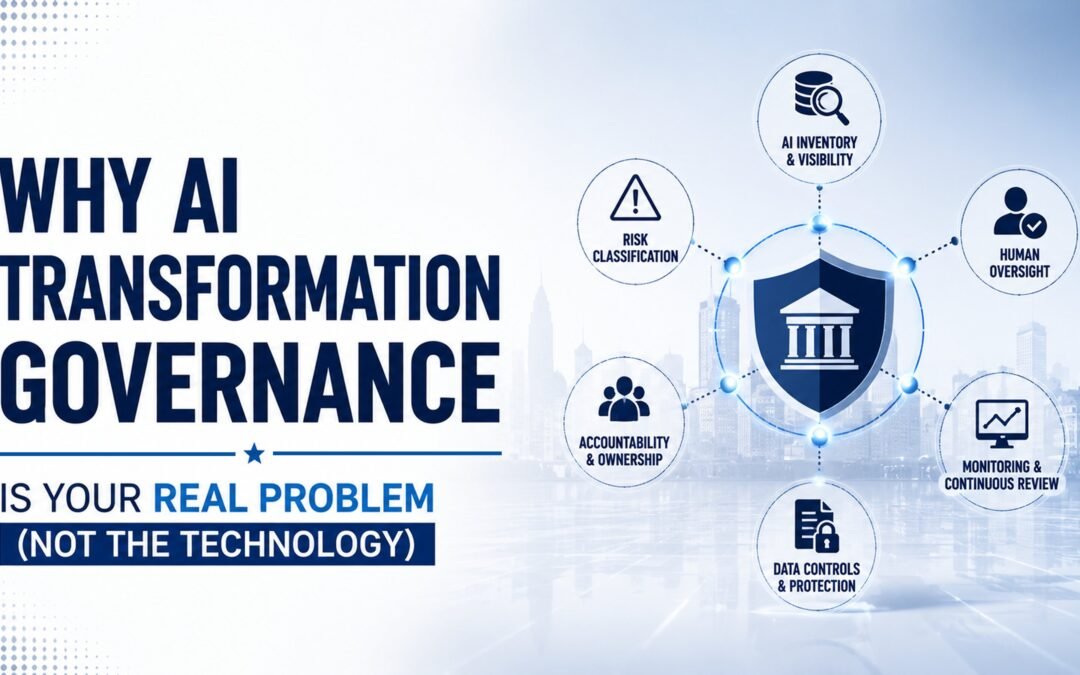
• Six steps create effective governance: Map your complete AI inventory, classify systems by risk level, define human oversight checkpoints, establish data controls, create continuous monitoring dashboards, and assign clear accountability using RACI frameworks.
Start with visibility you can’t govern what you can’t see. Organizations that build governance into AI architecture from day one transform compliance from a liability into a competitive advantage.
Organizations are investing $665B in enterprise AI by 2026, yet 73% of AI deployments fail to deliver promised ROI. Indeed, only 1% of companies describe themselves as AI-mature. The problem is not the technology. The problem is AI transformation governance. Without clear AI governance, organizations face security vulnerabilities, legal liability, compliance violations, and failed deployments that waste resources. In reality, 74% plan to deploy agentic AI within two years, yet only one in five have governance structures in place to manage autonomous systems safely. This article explains what risks organizations face without AI transformation governance, why traditional IT management approaches fail, and how to build governance frameworks that actually work.
What Risk Do Organizations Face Without Clear AI Governance
Employees at over 90% of organizations already use personal AI tools like ChatGPT at work, while only 40% of companies have purchased official licenses. This gap creates what security teams call shadow AI, and the consequences are measurable. About 38% of employees share confidential data with AI platforms without approval. One in five UK companies experienced data leakage because of employees using generative AI.
Shadow AI Creates Security Vulnerabilities
Samsung engineers inadvertently leaked confidential information by using ChatGPT to review internal code and documents, prompting Samsung to ban generative AI tools across the company. The incident highlights how sensitive data enters external AI systems without IT oversight. Similarly, 44% of organizations struggle with business units deploying AI solutions without involving IT and security teams. Employees paste customer emails into chatbots, upload proprietary datasets to external machine learning models, and integrate unauthorized tools into workflows. Each action bypasses security controls and monitoring, exposing organizations to data breaches they cannot track or prevent.
Accountability Gaps Lead to Legal Liability
When AI systems make discriminatory hiring decisions or cause financial harm, determining who bears responsibility becomes legally complex. The AI supply chain involves foundational model developers, software vendors, and deploying organizations, yet existing liability frameworks struggle to assign clear accountability. Courts are exploring theories that hold AI vendors directly accountable for discriminatory outcomes, while vendor contracts aggressively shift liability to customers through caps, limited warranties, and broad indemnification clauses. Organizations become legally responsible for algorithmic failures they cannot examine, audit, or fully understand.
Compliance Violations and Regulatory Penalties
Fines for GDPR noncompliance reach EUR 20,000,000 or 4% of worldwide revenue, whichever is higher. The EU AI Act establishes even steeper penalties: up to €35,000,000 or 7% of global annual turnover for prohibited AI violations. Companies that fail AI compliance checks face legal bills, court costs, and settlements that often exceed original fines. Regulatory enforcement will accelerate starting August 2026, particularly for general-purpose AI models.
Failed AI Deployments and Wasted Investment
A staggering 78% of organizations have had AI projects either fail outright or remain stuck in pilot stage despite record investment. Research examining 300 individual AI projects found that 95% of AI pilot projects failed to deliver any discernible financial savings. Purchased AI tools succeed 67% of the time, while internal builds pan out only 33% as often. Organizations lack the expertise to make AI work: 32% still don’t understand how to deploy it successfully.
Why AI Transformation Governance Is Different from Traditional IT Management
Traditional IT systems follow explicit rules. Enter the same data twice, get identical results. AI transformation governance requires a fundamentally different approach because AI systems operate on probability, not certainty.
AI Systems Are Probabilistic Not Deterministic
Deterministic AI operates on predefined logic: same input, same output, every time. Probabilistic AI functions through statistical pattern recognition, interpreting context and handling ambiguity. That variability becomes a liability when invoice approvals need to run identically for SOX compliance. Business processes are deterministic by design: payroll runs on fixed rules, regulatory reporting follows explicit formulas. But generative AI is probabilistic by nature. Hallucination rates in production LLM systems range from 15% to 20% for state-of-the-art models. Prompt-based mitigation reduced GPT-4o’s hallucination rate from 53% to 23%, still quite high. A single AI agent that’s 90% reliable on each action looks production-ready in isolation, but small error rates at each step compound fast.
Models Evolve and Degrade Over Time
Model drift refers to the degradation of machine learning model performance due to changes in data or in relationships between input and output variables. Models built with historical data quickly become stagnant as new data points introduce variations the old data cannot capture. A single end-to-end training run for an LLM with several hundred billion parameters can cost several million dollars. When data changes, the patterns your models learned may no longer hold true. Organizations must continuously monitor production models and retrain them when accuracy decreases below preset thresholds.
Autonomous Agents Operate Without Human Oversight
Autonomous AI agents make decisions without human intervention. Gartner predicts over 40% of agentic AI projects will be canceled by the end of 2027, largely because the hype around autonomous agents outpaces the governance infrastructure required to run them at scale.
The Real Reasons AI Transformation Governance Fails

Despite $35-40 billion in generative AI investments, only 5% of companies scale their AI projects successfully. The failure patterns are predictable and structural.
No Executive Sponsorship with Decision-Making Authority
Executive sponsorship failures account for 22% of governance breakdowns. Organizations need C-suite leadership actively engaged in defining business objectives, allocating resources, and removing organizational barriers, not passive approval of project proposals. High-performing AI organizations are three times more likely to have senior leaders who visibly champion AI adoption. When governance is delegated to committees without budget authority or cross-functional mandate, it becomes decoration rather than direction.
Treating Governance as Audit-Time Instead of Design-Time
The financial sector faces a velocity trap where AI-driven business outruns manual compliance speed, leading to regulatory failure. In industries where 91% of firms adopt AI for core operations, manual review becomes physically impossible. Governance frameworks traditionally evaluate outcomes after systems operate. However, this gap between deployment and discovery is where institutional risk accumulates. Building human oversight, auditability, and data controls into AI architecture from the beginning costs a fraction of post-incident remediation.
Siloed Teams Without Cross-Functional Coordination
Siloed accountability structures cause 19% of governance failures. Gartner research indicates 89% of AI-pursuing organizations established centralized AI functions, yet this hub-and-spoke architecture replicates the service provider model that transformed IT departments into organizational islands. Data scientists need compliance teams. Business leaders must align with IT operations. Organizations lacking mature cross-functional coordination pursue conflicting AI strategies and create competing data pipelines.
Missing Continuous Monitoring and Drift Detection
The absence of continuous monitoring and model drift detection accounts for 27% of failures. Model accuracy can degrade within days of deployment because production data diverges from training data. Organizations without real-time performance tracking discover problems only after they cause damage through compliance violations, customer harm, or public incidents.
Policy Documents That Never Reach Implementation Teams
While 76% of companies with AI strategies report management-level oversight, only 41% make their AI policies accessible to employees or require acknowledgement. Policies the engineering team never reads are theater, not governance.
How to Build AI Transformation Governance That Actually Works
Building functional AI transformation governance requires six interconnected steps that address the structural failures outlined earlier.
Map Your Complete AI Inventory First
A centralized AI inventory removes blind spots and exposes shadow AI use. This step creates visibility across every AI system in use, no matter how it entered the organization.
Classify Systems by Risk Level and Impact
Once AI systems are visible, assess risks they introduce using a risk taxonomy. High-risk decisions affect health, finances, or legal rights. Medium-risk impacts customer experience. Low-risk involves internal models. The outcome is a Risk Register listing all systems with assigned risk levels and mandated controls.
Define Human-in-the-Loop Checkpoints
Human-in-the-loop means humans are involved at some point in the AI workflow to ensure accuracy, safety, and accountability. The EU AI Act’s Article 14 requires high-risk systems be designed for effective human oversight, including manual operation, intervention, and real-time monitoring.
Establish Data Sovereignty and Access Controls
Organizations must control where data resides and how it’s used. Data sovereignty involves more than storage location; it encompasses how data flows through AI pipelines, who can access it, and how it’s protected during its lifecycle.
Create Continuous Monitoring Dashboards
Deploy real-time visibility into data flows, model behavior, and operational activity. Monitoring dashboards provide centralized interfaces with real-time visibility into how AI agents perform across workflows.
Assign Clear Ownership and Accountability
A RACI Matrix formalizes who is Responsible, Accountable, Consulted, and Informed for each phase of the AI lifecycle. Only one person or role can be Accountable for any given decision or outcome.
Conclusion
AI transformation governance determines whether your AI investments deliver value or waste resources. Without it, you face security breaches, legal liability, and failed deployments that drain budgets.
The framework we’ve outlined addresses the structural failures that cause 73% of AI projects to miss ROI targets. Start with a complete AI inventory, classify by risk, and build continuous monitoring into your systems from day one. When you implement these six steps correctly, you transform AI from a compliance liability into a competitive advantage.
FAQs
Q1. What are the main challenges organizations face with AI governance?
Organizations struggle with several AI governance challenges including security vulnerabilities from unauthorized AI tool usage, accountability gaps that create legal liability, compliance violations leading to regulatory penalties, and failed AI deployments that waste investment. Additionally, many companies lack the cross-functional coordination and continuous monitoring systems needed to manage AI systems effectively.
Q2. How is AI governance different from traditional IT management?
AI governance differs fundamentally because AI systems are probabilistic rather than deterministic, meaning they don’t produce identical outputs for the same inputs. Unlike traditional IT systems that follow explicit rules, AI models operate on statistical patterns and can produce variable results. AI systems also evolve and degrade over time, requiring continuous monitoring and retraining, while autonomous AI agents can make decisions without human intervention.
Q3. Why do most AI governance initiatives fail?
AI governance initiatives typically fail due to lack of executive sponsorship with real decision-making authority, treating governance as an audit-time activity instead of building it into system design, siloed teams without cross-functional coordination, missing continuous monitoring for model drift detection, and policy documents that never reach the implementation teams who actually build and deploy AI systems.
Q4. What is shadow AI and why is it a security risk?
Shadow AI refers to employees using personal AI tools like ChatGPT at work without official company approval or IT oversight. This creates security vulnerabilities because employees often share confidential data with these platforms, about 38% of employees share confidential information without approval. This bypasses security controls and can lead to data breaches, as demonstrated when Samsung engineers inadvertently leaked confidential information through ChatGPT.
Q5. What steps should organizations take to build effective AI governance?
Organizations should start by mapping their complete AI inventory to identify all systems in use, then classify systems by risk level and impact. Next, define human-in-the-loop checkpoints for critical decisions, establish data sovereignty and access controls, create continuous monitoring dashboards for real-time visibility, and assign clear ownership and accountability using frameworks like RACI matrices to ensure someone is responsible for each AI system outcome.
