
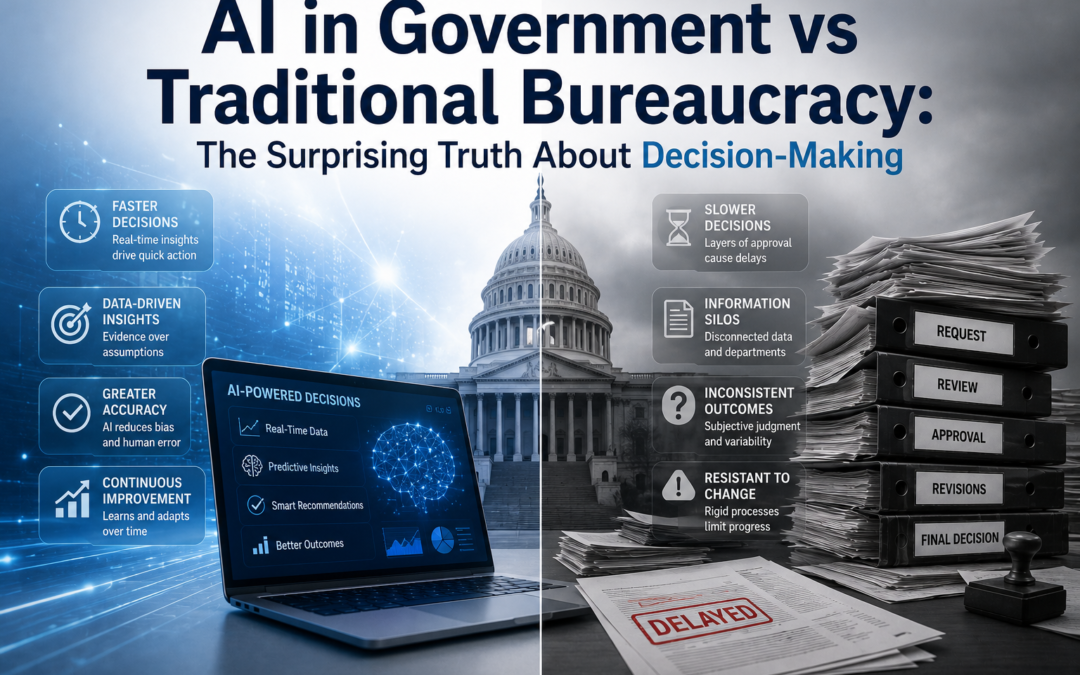
The debate about AI in government is framed incorrectly. In reality, the comparison is not AI versus human bureaucrats. The real question is whether government decisions should rely on outdated manual systems or technology-enhanced analysis. Bureaucracies have evolved from traditional street-level operations to screen-level systems, and are now becoming system-level bureaucracies where algorithms play larger roles in decision-making. States that effectively leverage AI in these transformations will gain significant advantages in efficiency and security. This article examines bureaucratic discretion definition, explores benefits of ai in government, analyzes ai in government decision-making processes, and reviews practical use of ai in government through real examples. Equally important, I’ll address what AI gets wrong and why hybrid models combining human judgment with technological capability represent the future.
Key Takeaways
The future of government isn’t about choosing between AI and humans, but creating hybrid systems that leverage both algorithmic efficiency and human judgment for better democratic governance.
• AI excels at speed and consistency, processing government applications 80 days faster than manual reviews while eliminating human bias and favoritism in routine decisions.
• Algorithms cannot replace human moral reasoning and empathy—they perpetuate historical biases and lack the contextual understanding needed for complex ethical decisions.
• Hybrid models combining AI efficiency with human oversight create “accountable discretion,” where technology handles routine tasks while humans retain authority over judgment-intensive cases.
• The geopolitical race for AI-enabled bureaucracies is reshaping global power, with the US, China, EU, and India each developing different visions for AI-driven government.
• Automation bias poses real risks—professionals increasingly follow incorrect AI recommendations, making it crucial to maintain human oversight in critical decision-making processes.
The transformation from street-level to system-level bureaucracies is inevitable. Success depends on preserving human elements like compassion and moral judgment while harnessing AI’s capabilities for routine processing and data analysis.
How Traditional Bureaucracy Makes Decisions
Bureaucratic discretion definition and its role
Administrative discretion refers to the authority granted to government officials to make decisions and interpret laws when implementing policies. Laws cannot cover every specific scenario, so bureaucrats use discretion to fill gaps and adapt rules to real-world complexities. This flexibility allows agencies to respond efficiently without needing constant legislative updates.
The Administrative Procedure Act of 1946 formalized this concept, giving agencies the power to develop rules and regulations that have the force of law. Bureaucratic discretion is not absolute. It operates within legal frameworks and oversight mechanisms established by elected representatives, maintaining democratic accountability.
Street-level bureaucrats and human judgment
Michael Lipsky popularized the term “street-level bureaucracy” in 1969 to describe government civil servants who interact directly with the public. These frontline workers include public school teachers, police officers, firefighters, social workers, and postal workers. They serve as the primary point of contact between government and citizens.
Lipsky asserts that discretion exists because human judgment is in the nature of service work that machines could not replace. A teacher receives detailed lists of required skills students must acquire but determines how to instill these skills within state parameters. A police officer pulling over a speeding driver might note extenuating circumstances, such as a man rushing his pregnant wife to the hospital, and not only ignore the penalty but assist in getting the expectant mother safely to care.
The three core values bureaucracies balance
Street-level bureaucrats navigate tensions between efficiency, equity, and voice in their work. Efficiency demands processing cases quickly with limited resources. Equity requires treating all citizens fairly and objectively. Voice means responding to individual circumstances and needs.
Lipsky describes chronic resource shortages as the most constraining condition. Demand for services always increases to match supply, perpetuating what he calls a “cycle of mediocrity”. Agency goals are often ambiguous or conflicting, providing no useful guidelines because they require consideration of too many unmeasurable factors.
Why human discretion developed in the first place
Discretion emerged as a necessary response to structural realities. Street-level workers face limited information, limited time, and rules that don’t always correspond to specific citizen contexts. They develop coping mechanisms and routines to feel they are doing their jobs well.
Discretion allows adjustment of general policy to specific circumstances and client needs. A social worker can tailor policy to fit the particular unemployed person they’re assisting. This freedom makes policies more meaningful for clients and enhances willingness among bureaucrats to implement programs effectively.
How AI in Government Decision-Making Actually Works
From street-level to system-level bureaucracies
Information technology transformed public agencies from machine bureaucracies into system-level bureaucracies. Street-level officials who once exercised discretion in client interactions have vanished in some realms. System analysts and software designers became the key actors in these executive agencies. Routine cases are now handled without human interference, as expert systems replace professional workers.
Digital discretion vs human discretion
Digital discretion shifts decision-making authority from frontline workers to those who design algorithms and databases. In contrast to human discretion that adapts to individual circumstances, digital systems follow predetermined logic patterns. Research shows this relationship is complex rather than conflict-ridden. Street-level bureaucrats transform into screen-level or system-level bureaucrats performing policy tasks with knowledge-based management systems.
AI as the indifferent bureaucrat
Algorithms function as indifferent bureaucrats, applying rules without moral dispositions or emotional considerations. They act as street-level bureaucrats rather than policymakers, making discretionary decisions about resource allocation. This indifference can be beneficial for consistency but problematic when cases require empathy or contextual understanding.
Real examples of use of ai in government
Across 11 federal agencies, AI use cases nearly doubled from 571 in 2023 to 1,110 in 2024, while generative AI applications increased nine-fold from 32 to 282. The FDA uses the CD5 handheld device with AI to detect counterfeit pharmaceuticals, reducing examination time from several minutes to seconds. The Social Security Administration’s Quick Disability Determinations process uses predictive models analyzing historical data from millions of applications to identify and expedite cases with high approval likelihood. Additionally, 67% of OECD countries already use AI to improve service delivery through chatbots, automated document processing, and predictive analytics.
The Surprising Truth: What AI Gets Right and Wrong

Benefits of ai in government: speed and consistency
AI excels at scale and speed in government operations. AI in government decision-making can process applications 80 days faster than manual reviews. Administrative tasks that once consumed 8+ hours now take under 20 minutes. This efficiency frees public servants to focus on judgment-intensive activities requiring human discretion.
Consistency represents another strength. Algorithms produce identical outputs for identical inputs, eliminating the variability inherent in human decision-making. When calibrated properly, automated systems minimize favoritism and expand applicant pools beyond what human gatekeepers could review.
The unexpected problem of moral dispositions
AI systems cannot understand right versus wrong or weigh moral trade-offs. They learn from historical data, and if that data contains biases related to race, gender, or age, the AI perpetuates them. Sandel notes that AI confers on these biases a kind of scientific credibility, making predictions seem objective when they’re not.
Correspondingly, the moral perspective cannot be automated. The decision about what forms of discrimination are morally justified ultimately rests with humans.
Automation bias and thoughtless decision-making
Automation bias describes our tendency to favor suggestions from automated systems even when contradictory information exists. In clinical settings, prescribing errors increased by 56.9% when doctors relied on incorrect system recommendations. More than half of professional pilots either disregarded important information or made dangerous mistakes when automated systems failed.
This phenomenon creates errors of commission, where incorrect advice is followed, and errors of omission, where necessary actions aren’t taken because systems don’t prompt them.
Opacity and the distance it creates
AI models function as black boxes, making it difficult to understand why particular decisions were reached. Algorithms are often protected as trade secrets, preventing public scrutiny. Without transparency, citizens cannot assess whether decisions are fair and unbiased.
Why AI can’t replace caregivers and rule enforcers
Caregiving requires noticing subtle changes that data cannot capture. A survey showed 68% of seniors wanted human caregivers for emotional support. Kennedy emphasized that AI will never replace compassion and the human element. Presence, touch, and being seen matter in ways machines cannot replicate.
What This Means for Democratic Governance
The geopolitical race for AI-enabled bureaucracies
States that successfully transform their bureaucracies with AI will grow in power and influence. This competition is already gaining momentum. Four clear players dominate: the United States leads in AI capital and hardware, China excels in domestic digital government implementation with high public support due to safety benefits, the European Union leverages regulatory influence as a “regulatory superpower,” and India has developed a successful digital transformation based on open-source technology and digital public goods.
Each actor represents a different vision for AI-driven government. The outcome will shape whether the future leans toward democracy or authoritarianism.
Hybrid models that combine human and AI discretion
Accountable discretion offers a balanced approach, giving frontline workers room to use judgment while using technology to make every decision traceable and reviewable. AI pulls relevant data to decision moments, handles routine paperwork, and leaves clear records of who decided what and why. Human-AI collaboration strengthens operational effectiveness by streamlining routine tasks while human agents oversee critical decisions, mitigate automation biases, and ensure fairness.
Scenarios for the future of government operations
Three plausible scenarios emerge. First, the EU becomes a global digital superpower while the US invests effectively in bureaucratic digital infrastructure. Second, the US withdraws from global commitments, prompting Europe, India, and possibly China to offer open-source AI alternatives. Third, the US withdraws or fails to invest while Europe falls short, resulting in China advancing rapidly and developing infrastructure for most digital governments worldwide.
Conclusion
All things considered, the question isn’t whether AI belongs in government but how we integrate it responsibly. Digital transformation will continue regardless of our preferences. The states that build effective hybrid models, balancing algorithmic efficiency with human judgment and moral reasoning, will lead this transition. Consequently, we must focus on creating systems where technology handles routine decisions while humans retain authority over cases requiring empathy, context, and ethical consideration.
FAQs
Q1. How does AI-based decision-making in government differ from traditional bureaucratic processes?
Traditional bureaucracy relies on human discretion and manual systems where officials interpret laws and adapt rules to individual circumstances. AI-based decision-making uses algorithms and automated systems that follow predetermined logic patterns, processing cases consistently and rapidly without the variability of human judgment. While traditional methods require manual updates for every new insight, AI systems can integrate new data automatically, making them faster but less adaptable to unique situations requiring empathy or moral reasoning.
Q2. What are the main advantages of using AI in government operations?
AI excels at speed and consistency, processing applications up to 80 days faster than manual reviews and reducing administrative tasks from over 8 hours to under 20 minutes. It produces identical outputs for identical inputs, eliminating human variability and potential favoritism. This efficiency allows public servants to focus on judgment-intensive activities while AI handles routine, high-volume tasks with greater scalability than traditional methods.
Q3. Why can’t AI completely replace human workers in certain government roles?
AI cannot replace roles requiring caregiving, moral judgment, and contextual understanding. Caregiving positions need the ability to notice subtle changes that data cannot capture, provide emotional support, and offer human presence and compassion. Additionally, AI lacks the capacity to understand right versus wrong or weigh moral trade-offs, making human oversight essential for decisions involving ethical considerations, empathy, and individual circumstances.
Q4. What is automation bias and how does it affect government decision-making?
Automation bias is the tendency to favor suggestions from automated systems even when contradictory information exists. This can lead to errors of commission, where incorrect AI recommendations are followed, or errors of omission, where necessary actions aren’t taken because systems don’t prompt them. In government settings, this bias can result in flawed decisions if officials over-rely on AI outputs without applying critical human judgment.
Q5. What does the future hold for AI integration in government bureaucracies?
The future likely involves hybrid models that combine AI efficiency with human discretion. These systems use AI to handle routine decisions, pull relevant data, and maintain traceable records, while humans retain authority over cases requiring empathy, context, and ethical consideration. Countries that successfully balance algorithmic efficiency with human judgment and moral reasoning will gain significant advantages in this ongoing digital transformation.
