
Most citizens don’t care whether AI and government converge in theory. They care whether their benefits arrive on time, their records stay accurate, and their questions receive quick answers. In truth, that practical focus matters because government AI solutions are already reshaping public services at scale. The U.S. government reported more than 1,757 AI use cases in 2024, more than double from 2023. Globally, over 1,000 AI policy initiatives now exist across 69 countries. AI could save the U.S. government more than $41 billion annually by streamlining processes. This transformation raises essential questions: How does the government use AI to deliver faster services? What makes agencies smarter? How do we build sustainable frameworks? We’ll examine the current state of govt AI adoption, explore how automation speeds service delivery, and outline the infrastructure needed for responsible implementation.
Key Takeaways
Government AI adoption is accelerating rapidly, with agencies moving from pilot programs to full-scale deployment to deliver faster, smarter public services that meet rising citizen expectations.
• AI dramatically reduces service wait times – From Shanghai’s 80% reduction in hospital waiting times to 70% faster permit processing in multiple cities
• Automated processing transforms claims and benefits – Veterans Affairs cut claim sorting from 10 days to half a day, while insurance claims now process in minutes instead of weeks
• Predictive analytics enables smarter decision-making – 65% of hospitals use AI for health predictions, while governments simulate policy outcomes 30% faster
• Success requires strong governance and training – 95% of AI pilots fail due to poor organizational culture and governance, not technology limitations
• Infrastructure investment is critical – Legacy IT systems and power requirements create major barriers, requiring strategic upgrades for sustainable AI deployment
The key to successful government AI lies in balancing innovation speed with responsible implementation, focusing on high-impact use cases while building citizen trust through transparent governance frameworks.
The current state of AI adoption in government services
Government AI solutions gaining momentum worldwide
Federal agencies lead adoption rates, with 64% of federal employees using AI applications daily compared to lower rates at state and local levels. According to a recent survey, 51% of government employees across all levels now use AI daily or several times weekly. Defense, intelligence, and law enforcement agencies have moved beyond experimentation, actively deploying computer vision, graph analysis, and deep neural networks to uncover suspicious activities in massive datasets.
The shift accelerated sharply over the past year. Public sector leaders report that 55% now use agentic AI in their organizations, with 42% deploying more than 10 AI agents. Half of all states currently use chatbots, 36% leverage AI for office productivity, and 26% apply it to code development. Civil and health agencies span the full spectrum, from conducting readiness assessments to operationalizing AI for climate analysis, trade surveillance, and fraud detection.
Even though 80% of government organizations remain at initial or developing digital maturity stages, momentum continues building. At least 10 states now require agencies to inventory AI applications, and governors in more than 10 states issued executive orders to study AI use in operations. New York’s experience illustrates this acceleration: 87% of employees across six pilot agencies want to use AI more in their work, prompting statewide rollout to several hundred thousand state employees.
Key drivers pushing agencies toward AI
Three forces converge to push government AI solutions forward. First, fiscal pressures make AI attractive as agencies seek to streamline operations and reduce costs while handling increasing service demands. Second, governments possess vast amounts of data that serve as inputs for AI systems, creating natural advantages for implementation. Third, technological breakthroughs have produced AI applications that are more practical and effective for government use.
Citizen expectations shift dramatically as technology matures. Now that residents experience instant, personalized service from private sector companies, they expect similar responsiveness from government. Additionally, agencies face increasingly complex challenges and large data volumes that exceed human cognitive processing capacity.
From pilot programs to full-scale deployment
In 2026, experimentation alone won’t suffice. The conversation shifted from “let’s try something” to active implementation at state, city, and education levels. Agencies cannot afford to remain in pilot mode when technology has matured and pressure to demonstrate impact mounts.
Further complicating this transition, major barriers persist. According to survey data, 48% of agencies cite unclear governance or ethical frameworks as the top obstacle, followed by lack of technology infrastructure at 30% and misalignment with agency needs at 30%. Most AI solutions still exist in exploratory phases rather than scaled implementations. Six-week pilots in low-risk environments rarely show meaningful impact, whereas focused, high-impact production deployments do.
How AI speeds up service delivery for citizens
Reducing wait times with automated processing
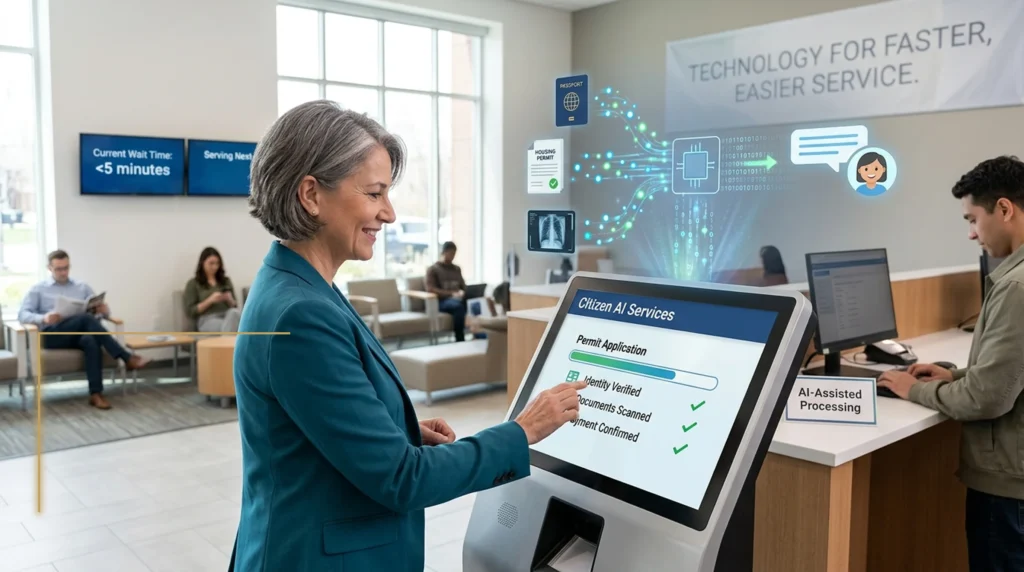
Wait times plague public services worldwide, with citizens often spending hours for basic transactions. AI changes this equation dramatically. An AI-assisted outpatient module in Shanghai reduced median waiting time from 1.97 hours to just 0.38 hours by automatically ordering imaging examinations and laboratory tests based on patient complaints. The system allows patients to complete tests before seeing a doctor, eliminating redundant waiting periods.
The U.S. Social Security Administration applies similar logic to disability and retirement claims. AI tools read and analyze medical records, application forms, and supporting documents, identifying key information that case officers need. By pre-organizing data, the technology helps human reviewers spend more time evaluating cases rather than searching through pages of documents. This approach reduces backlogs and improves decision accuracy while shortening waiting times for citizens.
Instant responses through intelligent assistants
Virtual assistants handle routine inquiries around the clock, freeing staff for complex cases. Portugal’s Virtual Assistant implementation produced a 10% increase in output for targeted public services. The U.S. Department of Consumer Affairs integrated Watson Assistant with its submission portal, eliminating an average of 6,200 calls per month and saving over 800 hours in waiting time.
Faster claims and benefits processing
The U.S. Department of Veterans Affairs spent too much time sorting claims from mail, fax, and online submissions. Manual labor delayed approvals, meaning beneficiaries waited longer for entitled benefits. AI reduced claim sorting time from 10 days to approximately half a day.
A large U.S. travel insurance company handling 400,000 claims annually faced three-week processing times. An AI-based solution achieved 57% automation, reducing processing time from weeks to minutes.
Streamlined permit and licensing systems
Honolulu’s Department of Planning and Permitting cut residential permit completion times by 70% using the CLARITI system. Virginia’s Permit Transparency platform delivered similar results, reducing average processing times by more than 70%. Minnesota unified over 30 professional licensing boards under a centralized system, achieving 60% faster approval timelines and a 30% reduction in application rework.
Making government smarter through AI-powered decision support
Data-driven policy making and planning
Public budgeting decisions affect all areas of policy and government programs. AI enables agencies to simulate potential outcomes before introducing regulations by testing decisions in virtual environments. According to analysis, AI-based simulations can reduce policy analysis time by up to 30%. This speed allows governments to react quickly to crises and evolving citizen needs.
Predictive modeling for public health
Approximately 65% of U.S. hospitals reported using AI-assisted predictive models]. These models were most commonly employed to predict inpatient health trajectories at 92% and identify high-risk outpatients at 79%.
Resource optimization and budget allocation
AI-driven analytics and optimization tools provide data-driven recommendations for prioritizing investments, optimizing spending, and maximizing ROI. Studies on Mexico’s federal budget distribution found investment in social development should be increased while non-program-based budgets should be reduced.
Enhanced threat detection and prevention
Public sector organizations report 38% have insufficient cyber resilience compared to 10% of private businesses]. Similarly, customers reported a 75% reduction in false positives with machine learning-powered anomaly detection, and achieved 36% reduction in annual risk exposure.
Personalized services based on citizen needs
By late 2024, Ireland’s MyWelfare platform auto-awarded more than 83% of illness benefit claims and 98% of treatment benefit claims.
Real-time monitoring and performance tracking
In fact, 60% of government AI and data analytics investments aim to directly impact real-time operational decisions and outcomes.
Building the foundation for sustainable AI in government
Establishing governance frameworks
Responsible govt AI requires structured oversight from the start. The NIST AI Risk Management Framework provides voluntary guidelines to incorporate trustworthiness into design, development, and evaluation of AI systems. DC became the first major U.S. city to ground AI governance in six core values: clear benefit to residents, safety and equity, accountability, transparency, sustainability, and privacy and cybersecurity. These frameworks balance innovation with ethical standards while maintaining regulatory compliance.
Training public servants for AI tools
The GSA AI Training Series meets requirements of the AI Executive Order, offering specialized tracks for government employees at all levels. DC’s mandatory Responsible AI training equips the workforce to use generative AI tools safely while reinforcing accountability. UNESCO supports capacity-building through its Digital Competency Framework, helping institutions identify gaps and deliver targeted training.
Infrastructure requirements and investments
Legacy IT systems create AI-readiness hurdles for most agencies. A single AI rack from Nvidia requires 125 kilowatts of power, while most D.C. metro data centers support only nine kilowatts. Federal lands are being identified for gigawatt-scale AI data centers powered by clean energy to advance national security and economic competitiveness.
Measuring success and ROI
Only 29% of executives can measure AI ROI confidently, even though 79% see productivity gains. Chiefly, 95% of generative AI pilots fail because organizational culture, governance, and data strategy constrain results more than technology.
Conclusion
AI and government partnerships deliver real results when agencies move beyond experimentation. We’ve seen wait times drop by 70%, claims processed in minutes instead of weeks, and services personalized for individual citizens. Obviously, challenges remain around infrastructure, governance, and measuring ROI.
For government leaders, the path forward requires balancing speed with responsibility. Start with high-impact use cases, invest in workforce training, and build frameworks that citizens can trust. The technology works when implementation matches ambition.
FAQs
Q1. How does AI help reduce waiting times in government services?
AI automates routine processing tasks and enables intelligent scheduling systems. For example, AI can pre-process applications, automatically organize documents, and predict peak service times so agencies can allocate resources more effectively. This has resulted in wait time reductions of up to 70% in some permit and licensing systems.
Q2. What are the main benefits of AI for public service delivery?
AI enables faster claims and benefits processing, provides instant responses through virtual assistants available 24/7, and allows agencies to handle routine tasks automatically. This frees government employees to focus on more complex cases that require human judgment, ultimately improving both speed and quality of service for citizens.
Q3. How does AI support better decision-making in government?
AI provides data-driven insights through predictive modeling and simulation tools that help agencies test policy decisions before implementation. It can analyze large datasets to optimize resource allocation, identify patterns for threat detection, and enable real-time performance monitoring, reducing policy analysis time by up to 30%.
Q4. What challenges do governments face when implementing AI?
The biggest obstacles include unclear governance frameworks (cited by 48% of agencies), lack of adequate technology infrastructure, and outdated legacy IT systems. Additionally, many agencies struggle to measure return on investment, with only 29% of executives able to confidently assess AI ROI despite seeing productivity improvements.
Q5. What infrastructure is needed for sustainable government AI programs?
Successful AI implementation requires modern data centers with sufficient power capacity, clean energy sources, updated IT systems to replace legacy infrastructure, and comprehensive workforce training programs. Agencies also need established governance frameworks that ensure accountability, transparency, and ethical use of AI technologies.
