
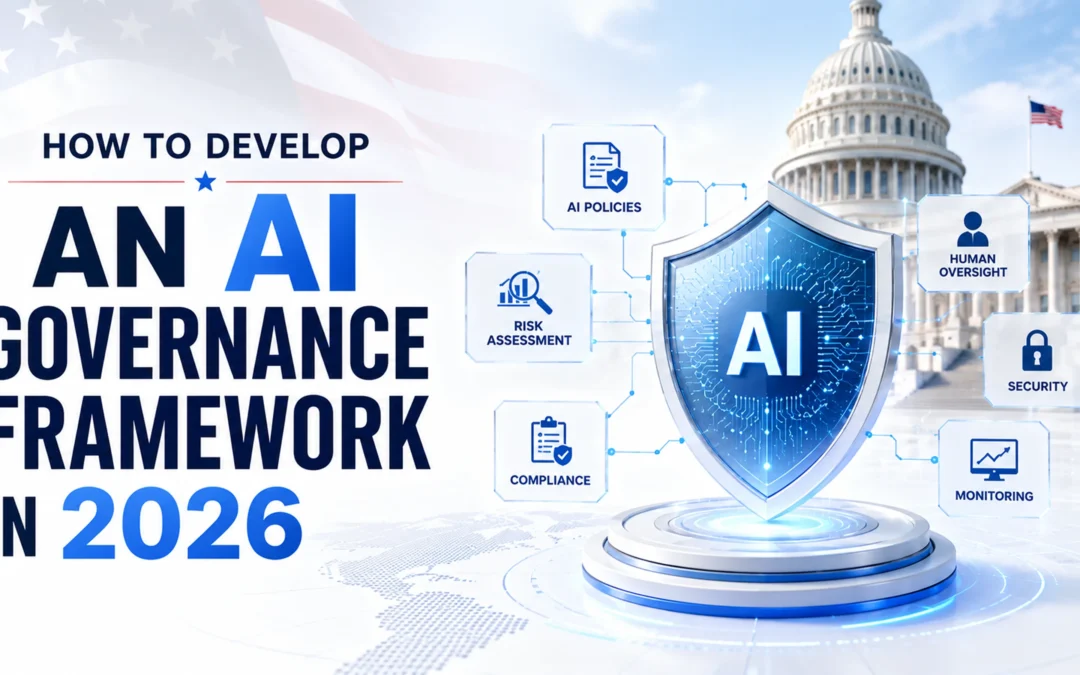
Developing an AI governance framework means building the operating system your organization uses to decide where AI is allowed, who approves it, what data it can touch, and how harm gets caught before it spreads. Lawrence Rufrano’s work on SSA modernization and federal AI accountability shows exactly what happens when that operating system is missing: real people pay the price.
Quick Answer:
- Builds trust by making AI systems transparent, explainable, and responsibly managed.
- Defines clear AI policies, roles, and responsibilities across the organization.
- Establishes approval workflows before AI systems are deployed.
- Classifies AI use cases by risk to apply appropriate governance controls.
- Ensures compliance with regulations such as the NIST AI RMF and OMB guidance.
- Monitors AI performance, bias, and security throughout the AI lifecycle.
- Creates accountability through audit trails, incident response plans, and named owners.
What Is an AI Governance Framework?
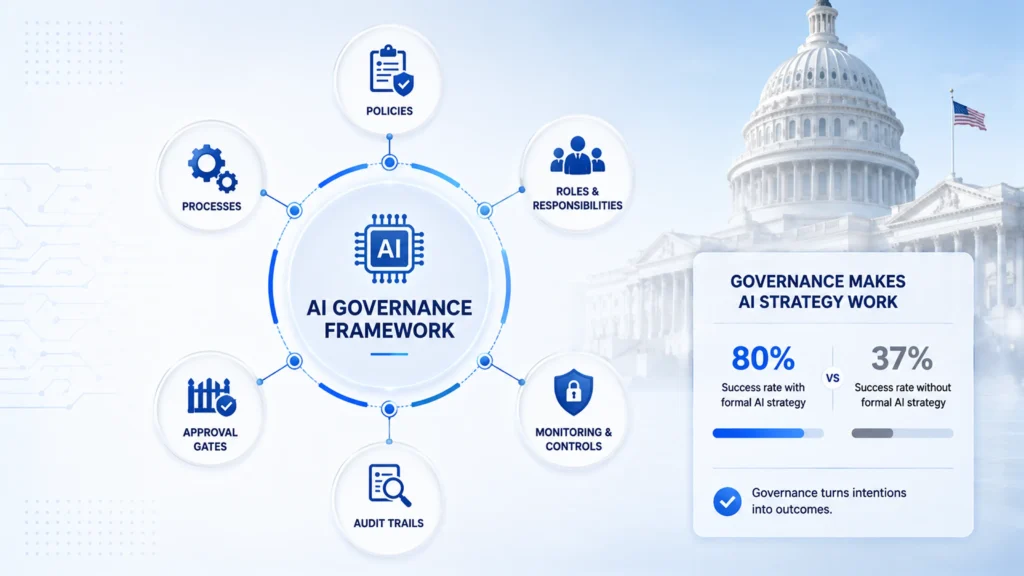
A working AI governance framework is the structured combination of policies, roles, processes, and monitoring controls that guide how an organization develops, procures, and oversees AI systems throughout their lifecycle. Most organizations have a policy document. Far fewer have a governance system.
Why a Governance System Matters More Than a Policy
That gap matters enormously in practice. A policy document states intentions. A governance system enforces them through approval gates, named owners, audit trails, and a clear escalation path when something goes wrong.
Writer research finds organizations with a formal AI strategy achieve an 80% success rate in AI adoption, compared with 37% for those without one. However, that figure comes from vendor-commissioned research rather than an independent study, so treat it as directional rather than definitive. That 43-point spread is almost entirely explained by whether governance is operational or decorative.
The framework answers four questions at every stage: Is this AI use permitted? Who approved it? What data rules apply? And who is responsible when it fails?
Which Risks, Rules, and Owners Need to Be in Place First?
Name your risk categories before you name your tools. The main categories are performance risk (the model is wrong), bias risk (the model is systematically wrong for a protected group), security risk (the model is exploited), and compliance risk (the model violates a law or regulation). Each category needs a named owner with clear accountability, not a committee.
The Five Roles Every AI Governance Framework Needs
| Role | What they own |
| Business owner | Approves the use case; accountable for outcomes |
| Model owner | Responsible for model performance and retraining |
| Legal/compliance | Confirms regulatory alignment before deployment |
| Security | Reviews data access and adversarial risk |
| Review board | Signs off on high-impact or novel deployments |
The 2024 IAPP Governance Survey found that only 28% of organizations have formally defined oversight roles for AI governance, which means most teams are improvising accountability after the fact.
The Vendor AI Challenge Most Organizations Miss
Third-party and vendor AI is the edge case that breaks most frameworks. If a vendor’s algorithm denies a benefits claim or flags a transaction incorrectly, your organization still owns the outcome. Accountability can’t travel outside your organization just because the model does.
Sector-specific risks vary considerably: the harms posed by clinical decision-support tools differ from those in benefits administration, law enforcement, or worker-protection contexts. Map vendor AI to the same risk tiers as internal models, and require contractual audit rights before procurement begins.
How Do You Build an AI Governance Framework Step by Step?
This is where most organizations stall. They agree on principles and then wait for someone else to operationalize them. The sequence below is the one that actually ships.
Step 1: Inventory every AI use case
Start with a complete list of where AI is already operating, beginning with what is deployed today rather than what is planned for tomorrow. Shadow AI is common, and you can’t govern what you haven’t found. Research from Evolvance Market Research (2026) suggests 35% of organizations describe shadow AI as pervasive or widespread, with another 45% characterizing it as moderate in prevalence.
For each use case, record the business function, the data inputs, the decision it influences, and whether a human reviews the output. That last field is your first risk signal.
Step 2: Tier use cases by impact
A spell-checker and an automated benefits-denial system are both “AI,” but treating them identically wastes resources and buries the real risks. High-impact AI uses include any system whose output serves as a principal basis for a decision that could create significant risks to civil rights, civil liberties, privacy, or safety. A three-tier model works for most organizations:
- Tier 1 (High): AI that directly affects individual rights, benefits, or safety. Requires full review board sign-off.
- Tier 2 (Medium): AI that informs decisions but with human review. Requires legal and security sign-off.
- Tier 3 (Low): Productivity tools with no decision authority. Requires business owner acknowledgment only.
Step 3: Set approval gates and document data rules
Every Tier 1 and Tier 2 use case needs a formal approval gate before deployment. The gate should require a bias and performance test result, a data lineage record (what training data, from where, under what license), a security review, and a named incident response contact.
The table below converts those requirements into a structured artifact teams can adapt directly.
| Gate Field | What to document | Who provides it | Blocking if missing |
| Bias/performance test result | Test methodology, demographic subgroups evaluated, pass/fail against performance floor | Model owner | Yes |
| Data lineage record | Training data source, license, date of last update | Model owner | Yes |
| Security review sign-off | Data access scope, adversarial risk assessment, reviewer name | Security | Yes |
| Named incident response contact | Individual name, role, and escalation order | Business owner | Yes |
Data rules are the controls that get skipped most often. Teams document the model but not the data pipeline. When something goes wrong, that gap is exactly where accountability disappears. The federal AI governance platform work I’ve been involved with treats data provenance as a required field because, in practice, it’s the first thing that goes missing in a dispute.
Step 4: Test for bias and performance before launch
Run your model against demographic subgroups relevant to the decision it makes. For AI applications in public-sector or benefits contexts, this step is especially consequential because a systematic error in those settings can affect thousands of people before anyone notices. In 2024, the Biden administration’s OMB released Memorandum M-24-10, establishing a government-wide framework for responsible AI use, including requirements for risk assessments, transparency, and safeguards for high-impact systems.
Document the test results and set a performance floor. If the model falls below it after retraining, it goes back to the review board.
Step 5: Define incident response and escalation
An incident response plan for AI has three parts: detection (how you know something went wrong), containment (how you stop the harm), and escalation (who gets called and in what order). Most frameworks write the first two and skip the third. When a federal AI system misclassifies a Social Security disability claim, the escalation path determines whether one person is harmed or ten thousand are. That’s not a hypothetical. It’s the mechanism behind the SSA record failures that drove my own prosecution.
How Do You Keep an AI Governance Framework Effective After Launch?

A governance framework that nobody follows is worse than no framework at all, because it creates the illusion of control. The controls that tend to atrophy first are audit trails and review cadence.
Set a Regular Governance Review Cadence
Every Tier 1 use case should be reviewed quarterly; Tier 2 annually. The review asks three questions: Has the model’s performance drifted? Has the regulatory environment changed? Has the use case expanded beyond its original scope? That last question catches the most problems. Under Trump’s OMB Memorandum M-25-21, every federal agency is required to publish both an AI Strategy and an AI Compliance Plan outlining how it will govern its high-impact AI systems, and the private sector is moving toward similar expectations.
Three Common Reasons AI Governance Programs Fail
Most frameworks don’t fail at launch. They fail six months later, quietly.
1. Paper-only governance:
Policies exist, but no one enforces the approval gates. The fix is tying deployment access to a completed governance record, so the gate is structural and enforced by the process itself.
2. Unclear ownership:
Research from the IAPP shows no single function owns more than a quarter of AI governance responsibility across IT, risk management, cross-functional arrangements, and dedicated AI governance teams. Assign a named individual with a clear mandate, rather than a team name on an org chart.
3. One-size-fits-all controls:
Applying Tier 1 scrutiny to every tool kills adoption. Applying Tier 3 scrutiny to high-stakes decisions causes harm. The tiering system in Step 2 is the fix.
Your AI Governance Implementation Checklist
If you’re starting from zero, work through these in order:
- Complete the AI inventory (you can’t govern what you haven’t found)
- Assign the five roles to named individuals
- Tier your use cases by impact
- Build the approval gate for Tier 1 and Tier 2
- Schedule the first quarterly review before you launch anything
For context on why SSA modernization and Social Security reform demand specialized governance controls for benefits AI, the social security advocacy and reform platform details the human cost of ungoverned automated decisions. My background is in finance and technology, including prior work at the Federal Reserve, and the wrongful wire-fraud prosecution I faced grew directly from SSA record failures. This is a concrete policy concern with real consequences for real people.
Conclusion
An AI governance framework is effective only when it goes beyond policy and becomes part of everyday operations. Organizations that define clear ownership, classify AI systems by risk, establish approval workflows, monitor performance, and review governance regularly are better prepared to deploy AI responsibly while maintaining trust, compliance, and accountability. Whether you’re building AI internally or managing third-party solutions, governance should be embedded into every stage of the AI lifecycle—not added after problems arise.
Frequently Asked Questions
1. What Is the Difference Between an AI Policy and an AI Governance Framework?
Ans: A policy states what is permitted or prohibited, and a governance framework is the operational system that enforces the policy through roles, approval gates, audit trails, and escalation paths. You need both, but a policy without the framework behind it changes nothing.
2. Does a small organization need a full AI governance framework?
Ans: Yes, scaled to fit. A small team doesn’t need a formal review board, but it does need one named person who approves AI use cases, a simple data-use rule, and a written incident response contact. The structure matters more than the headcount.
3. How does AI governance apply to Social Security or benefits administration specifically?
Ans: Consider an automated system that flags a beneficiary’s record as fraudulent based on a data mismatch, exactly the kind of SSA record failure that triggered a wrongful prosecution. Without a human-review gate and a clear escalation path, that error compounds across thousands of records before anyone catches it. Benefits AI sits at the highest-stakes end of the spectrum because errors affect individuals’ income and legal standing directly.
4. Which regulatory frameworks should I align with when building federal AI governance?
NIST published the voluntary AI Risk Management Framework, building a common U.S. risk-management vocabulary around Govern, Map, Measure, and Manage. For federal agencies, OMB Memorandum M-25-21 sets the current compliance floor. Both are the right starting points.
5. How often should an AI governance framework be reviewed?
At minimum, annually for the overall framework, and quarterly for high-impact use cases. An unscheduled review should also trigger any time a new law passes, a model is significantly retrained, or an incident occurs.
