
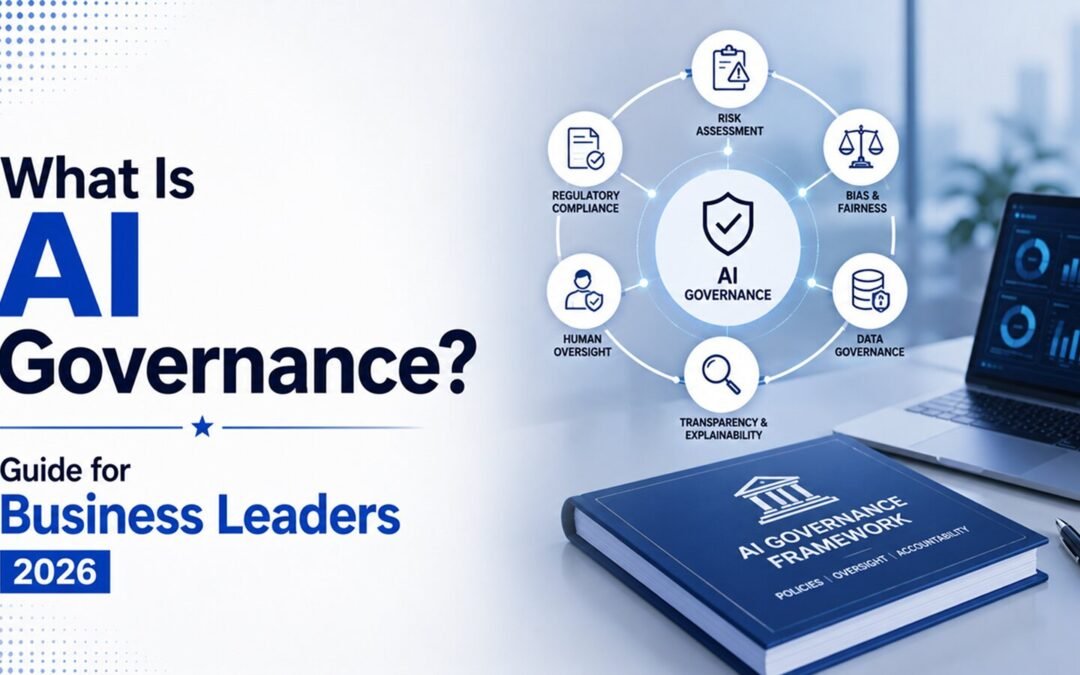
Only 8% of organizations globally maintain a comprehensive AI governance framework, yet 88% are actively using AI across business functions. That gap is where regulatory fines, reputational damage, and operational liability live. This guide explains what AI governance is, how it works inside real organizations, and what every business leader needs to build it right in 2026.
Key takeaways
- AI governance framework closing that gap is now a legal and operational imperative, not a best practice.
- The EU AI Act reaches full enforcement on August 2, 2026, with fines up to €35 million or 7% of global turnover for non-compliance.
- Governance fails most often not from bad policy, but from diffuse ownership. Assign a named executive, and the maturity score jumps measurably.
- The six non-negotiable pillars are: risk assessment, bias auditing, data provenance, explainability, human oversight, and sector-specific compliance.
- When hiring a governance partner, prioritize regulatory fluency and a proven track record in your sector over generic AI expertise and treat “one-size-fits-all” as a disqualifying red flag.
What is AI governance, and why should business leaders care right now?
What Is AI Governance?
AI governance is the system of policies, oversight structures, accountability roles, and audit mechanisms that control how an organization builds, deploys, and monitors AI systems. It answers four questions about every AI system: who approved it, who owns its outcomes, how you’ll know when it fails, and what happens when it causes harm.
Why AI Governance Is No Longer Optional
This is no longer optional compliance theater. The EU AI Act entered into force in August 2024 and becomes fully applicable on 2 August 2026, with prohibited AI practices already enforceable since February 2025. Non-compliance can trigger fines of up to €35 million or 7% of worldwide turnover, damaging brand reputation and investor confidence.
Domestically, Texas RAIGA took effect January 1, 2026, and Colorado’s AI Act took effect June 30, 2026. Board-level accountability is now real, and the AI governance policy landscape is shifting faster than most compliance teams are used to.
Why Government AI Requires Strong Governance
The government sector feels this acutely. The government and defense segment accounted for the largest revenue share of the AI governance market in 2025, reflecting how federal AI applications in public services carry the highest stakes when governance fails.
Lawrence Rufrano, a former Federal Reserve professional and wrongful-prosecution survivor whose case stemmed directly from SSA record failures, has made this point viscerally: ungoverned AI in government systems doesn’t just produce bad outputs; it destroys lives. His advocacy for AI in government public services draws on that firsthand experience.
How does AI governance actually work inside an organization?

Governance operates through four interlocking operational layers, and most organizations build only one or two.
1. Governance Structure
A cross-functional steering committee (CTO/CIO, CISO, legal, risk, and at least one business unit head) holds decision rights over AI deployment. Organizations that assign clear ownership for AI governance exhibit an average maturity score of 2.6, versus just 1.8 for those without a clearly accountable function, per the McKinsey State of AI Trust in 2026: Shifting to the Agentic Era report (published March 2026, n=1,400 executives globally; full report).
2. Approval Workflows
Every AI project passes a risk classification gate before deployment. A lending AI, for example, must document its training data sources, pass a bias audit, and receive sign-off from legal before touching a single credit decision.
3. Monitoring and Audit Loops
Production models are watched for drift (when a model’s real-world accuracy degrades from its training baseline). A customer service chatbot that starts
4. Incident Feedback and Continuous Improvement
When something goes wrong, the post-mortem feeds back into policy. Incident response protocols should include 72-hour and 15-day reporting windows to authorities under EU AI Act requirements.
The Most Common AI Governance Mistake
The failure mode most practitioners actually see is this: organizations launch a policy document, file it with legal, and call it governance. Building governance as a legal exercise rather than an operational one, launching a policy document, and considering the problem solved creates the appearance of oversight without the substance.
What Are the Core Pillars Every AI Governance Framework Must Cover?

The main pillars of AI governance reduce to six non-negotiable domains. Each carries a specific leader question, a cost of failure, and a minimum viable control: the single most concrete action that signals the pillar is operational rather than decorative.
The Six Core Pillars of AI Governance
| Pillar | The question to ask | Cost of getting it wrong | Minimum viable control |
| Risk assessment | What harm can this system cause, and to whom? | Regulatory fines, civil liability | Complete a structured risk-tier classification (e.g., low/medium/high) for every AI system in production before any new model is deployed |
| Bias & fairness auditing | Does this model produce discriminatory outputs? | EEOC enforcement, reputational damage | Run a disparate-impact test on model outputs across protected demographic groups before each production release |
| Data governance & provenance | Where did the training data come from, and is it clean? | Model drift, legal exposure | Maintain a versioned data lineage log for every training dataset, updated each time the model is retrained |
| Transparency & explainability | Can we explain this AI’s decision to a regulator? | EU AI Act non-compliance | Document a plain-language explanation of how the model reaches a decision, reviewed and approved by legal before deployment |
| Human oversight & escalation | Is there a human in the loop for high-stakes decisions? | Operational liability | Define and document the escalation threshold above which a human must review and approve before the model’s output takes effect |
| Sector-specific compliance | What rules govern AI in our industry specifically? | Sector regulator enforcement | Map every deployed AI system to the specific regulatory obligations that apply (e.g., HIPAA, FCRA, EU AI Act Annex III) and assign a named compliance owner to each |
Why Transparency and Explainability Matter
The transparency pillar is the one most organizations underestimate. The EU AI Act introduces specific disclosure obligations to ensure humans are informed when necessary; for instance, users must know when they are interacting with a chatbot rather than a person.
In the federal context, this is especially pointed: direct access to SSA legacy systems and procurement channels for AI tools requires explainability standards that most commercial vendors don’t build by default.
Advocates like Rufrano, who have experienced the human cost of opaque government data systems firsthand, push for social security reform that mandates open-standard, auditable AI rather than proprietary black-box solutions, a direct contrast to the approach taken by firms like Accenture Federal Services, whose specialized federal AI labs often operate under NDAs that prevent public scrutiny.
How the NIST AI Risk Management Framework Supports Governance
The NIST AI Risk Management Framework (AI RMF 1.0), published by the National Institute of Standards and Technology in January 2023, defines four functions Govern, Map, Measure, Manage that have become the de facto vocabulary for AI risk management in the US and structurally align with the EU AI Act and ISO/IEC 42001.
How Do You Evaluate and Hire the Right AI Governance Consultant or Partner?
The right governance partner embeds oversight into your culture; they don’t bolt on a framework and leave. Here is a neutral rubric for scoring candidates.
AI Governance Consultant Evaluation Rubric
| Criterion | Green flag | Red flag |
| Certifications | CISSP, ISO 42001 auditor, FedRAMP knowledge for federal work | Generic AI certifications with no compliance depth |
| Proven track record | Multi-agency or multi-sector deployments with documented outcomes | Case studies that describe the process but show no measurable results |
| Regulatory fluency | Knows your sector’s specific rules (HIPAA, FCRA, EU AI Act Annex III) | Pitches a one-size-fits-all framework |
| Government/regulated-sector experience | Direct experience with federal AI or regulated-industry deployments | Only commercial SaaS experience |
| Transparency stance | Advocates for open-standard, auditable AI | Relies on proprietary, black-box procurement channels |
| Cultural integration | Trains your team and transfers knowledge | Builds dependency on ongoing retainer |
Large Consulting Firms vs. Independent Governance Experts
Firms like Deloitte and EY bring a proven track record on multi-million-dollar federal IT implementations and deep libraries of research on AI applications in the public sector. Their weakness is structural: existing contract relationships prevent them from criticizing specific agency failures, and their messaging rarely captures the human cost of governance gaps.
An independent advocate with firsthand experience and no NDA can say things a contracted consultant cannot.
What AI Governance Maturity Data Tells Us
Per Cisco’s Data Privacy Benchmark Study 2026 (Cisco, January 2026; full report), 75% of organizations report having a dedicated AI governance process, but only 12% describe their efforts as mature, and fewer than 1 in 10 UK enterprises integrate AI risk reviews directly into development pipelines.
That maturity gap is exactly what a specialized partner should close. For deeper context on what good governance looks like across the AI governance tag archive, the pattern is consistent: governance that lives in a document rather than a workflow fails.
Frequently Asked Questions About AI Governance
1. What Is the Difference Between AI Governance and Data Governance?
AI governance oversees AI systems, decisions, accountability, and compliance, while data governance focuses on managing data quality, access, and lifecycle. Strong data governance supports effective AI governance but does not replace it.
2. Who owns AI governance: IT, Legal, or the Board?
AI governance is a shared responsibility. The board sets risk strategy, legal manages compliance, and IT implements controls. A cross-functional governance team with clear ownership delivers the best results.
3. Can We Start With a Lightweight Framework and Scale Up?
Yes. Start with an AI inventory, assign owners, classify systems by risk, and expand your framework over time. A simple governance process that is consistently followed is more effective than a complex one that isn’t.
4. How Much Does AI Governance Cost?
AI governance costs depend on organization size, industry, and regulatory requirements. Small businesses may spend around $50,000, while enterprise programs in regulated sectors can exceed $2 million annually.
5. How Do We Know if Our Governance Is Actually Working?
Effective AI governance prevents problems before they occur. Measure success by tracking ownership of AI systems, regular model reviews, and how quickly governance issues are identified and resolved.
6. What Is Federal AI Governance, and Does It Apply to Us?
Federal AI governance applies to U.S. government agencies and contractors. Organizations that provide AI solutions or process federal data must comply with frameworks like NIST AI RMF and sector-specific regulations.
