
With an increasing integration of AI into governmental and organizational operations, AI governance becomes essential to achieve a state of compliance, trust, and efficiency. The primary reason behind it is the visible negative impact of AI technologies’ deployment and application in organizations. In fact, research from IBM Institute for Business Value found that 80% of business leaders see AI ethics, bias, trust, or explainability as a major roadblock while adopting generative AI. However, AI governance helps organizations to address these challenges and prevent the adverse impact of AI technology use.
Quick Answer:
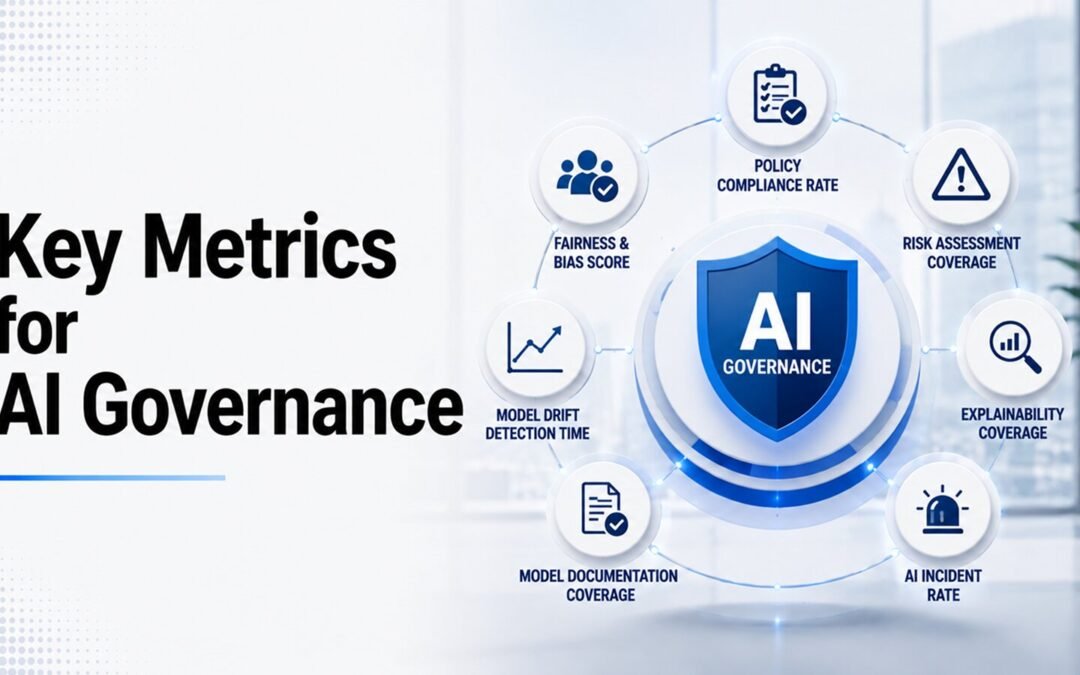
The most important AI governance metrics include:
- Policy Compliance Rate (PCR)
- Risk Assessment Coverage (RAC)
- Model Documentation Coverage (MDC)
- Fairness and Bias Score (FBS)
- Explainability Coverage
- Model Drift Detection Time (MDDT)
- AI Incident Rate
These metrics help organizations measure AI compliance, fairness, transparency, security, and overall governance effectiveness.
AI governance refers to the policies, processes, standards, and controls that guide the responsible development, deployment, and monitoring of AI systems. It helps organizations ensure that AI remains ethical, transparent, secure, compliant with regulations, and aligned with business objectives. Yet, establishing governance policies alone is not enough. Organizations also need measurable indicators to evaluate whether these governance efforts are effective. That is why identifying the key metrics for measuring AI governance is essential. In this article, you will go through some important metrics that may assist you in measuring the performance of your AI governance.
What are AI governance metrics?
AI governance metrics are measurable indicators used to evaluate whether AI systems are operating ethically, securely, transparently, and in compliance with organizational policies and regulations. They provide organizations with objective data about the health, reliability, and trustworthiness of their AI systems. They help decision-makers monitor performance, identify risks, maintain compliance, and continuously improve AI operations.
Importance of AI governance metrics
A 2025 KPMG U.S. Trust in AI Survey found that AI adoption is outpacing governance. While 70% of U.S. workers are eager to benefit from AI and 61% already report positive impacts, only 41% trust AI. Furthermore, 43% of Americans have low confidence that businesses and governments will develop and use AI responsibly. However, AI governance metrics assist in the responsible use of AI, increasing the success rate.
AI governance or ‘Responsible Use of AI’ is an ongoing process, and its regulations continue to evolve; data changes over time, and AI models may gradually lose accuracy or develop unintended biases. Without continuous measurement, organizations may overlook issues that can result in financial losses, legal penalties, reputational damage, or declining customer trust.
Measuring governance allows organizations to determine whether AI systems:
1. Comply with legal requirements,
2. maintain acceptable levels of fairness,
3. produce reliable results,
4. And protect sensitive information.
Governance metrics also improve accountability by providing evidence that AI decisions are being monitored and managed responsibly.
Furthermore, organizations that track governance metrics are better prepared for:
1. audits,
2. regulatory inspections,
3. and customer inquiries regarding AI usage.
Rather than reacting to problems after they occur, businesses can proactively identify potential risks and address them before they become significant issues.
In short, AI governance metrics help organizations monitor AI performance, reduce risks, ensure regulatory compliance, detect bias, improve transparency, and build stakeholder trust.
Potential harms related to AI systems

According to NIST AI RMF 1.0, AI harms can be classified into three categories:
Harm to People: When AI harms a person’s civil liberties, rights, physical or psychological safety, or economic opportunity; leads to discrimination against a population; affects democratic participation or educational access.
Harm to an Organization: When AI harms an organization’s business operations, security, or finances.
Harm to an Ecosystem: When AI harms interconnected resources, the global financial system, supply chain, natural resources, environment, and planet.
Key metrics for AI governance
There are certain international organizations responsible for introducing metrics or measuring AI governance
1. Policy Compliance Rate (PCR): PCR measures the percentage of AI systems that comply with internal governance policies, industry standards, and regulatory requirements. It helps organizations evaluate whether AI development and deployment align with legal, ethical, and organizational expectations.
2. Risk Assessment Coverage (RAC): RAC measures the proportion of AI systems that have undergone formal risk assessments before deployment. These assessments identify potential ethical, security, privacy, and operational risks and guide appropriate mitigation strategies.
3. Model Documentation Coverage (MDC): MDC evaluates the percentage of AI models with complete documentation, including model cards, training data sources, intended use, performance metrics, limitations, and version history. Comprehensive documentation improves transparency and accountability.
4. Fairness and Bias Score (FBC): FBC measures whether AI systems produce equitable outcomes across different demographic groups using metrics such as demographic parity, equal opportunity, or disparate impact. It also tracks the presence of algorithmic bias during testing and production.
5. Explainability Coverage: Indicates the percentage of AI models capable of providing clear, understandable explanations for their predictions or recommendations. Explainable AI enables users and regulators to understand how decisions are made.
6. Model Drift Detection Time (MDDT): It measures how quickly organizations detect changes in data distributions or model performance after deployment. Early drift detection allows timely retraining to maintain model accuracy and reliability.
7. AI Incident Rate: It tracks the number of AI-related incidents, including inaccurate predictions, bias complaints, privacy breaches, security events, or system failures, over a defined period. A lower incident rate indicates stronger AI governance.
AI Governance Metrics and their importance
All the discussed standards possess specific importance relative to AI governance, as discussed below.
| AI Governance Metric | Why It Matters |
| AI Policy Compliance Rate | Ensures regulatory compliance and reduces legal and reputational risks. |
| Risk Assessment Coverage | Helps organizations proactively identify and manage AI-related risks. |
| Model Documentation Coverage | Supports audits, explainability, and regulatory compliance. |
| Fairness and Bias Score | Promotes ethical AI and minimizes discriminatory outcomes. |
| Explainability Coverage | Builds stakeholder trust and supports responsible AI practices. |
| Model Drift Detection Time | Ensures AI systems remain accurate and effective over time. |
| AI Incident Rate | Helps evaluate the overall effectiveness of AI governance and continuous monitoring. |
Standards aligned with AI governance metrics:
The above-enlisted metrics are inspired by some international standards discussed below:
1. ISO/IEC 42001: The standard is applicable across all industries and relevant for public sector agencies as well as companies or non-profits involved in developing, using, or providing AI-based products or services. It is designed to provide comprehensive guidance for responsible use of AI.
2. NIST AI RMF: NIST AI RMF provides a structured approach for organizations to manage risks associated with artificial intelligence, ensuring responsible and trustworthy AI use.
Best Practices for Measuring AI Governance

Measuring AI governance effectively requires more than tracking a few key performance indicators (KPIs). Organizations should establish a structured approach that aligns governance metrics with business objectives, regulatory requirements, and ethical AI principles. The following best practices can help organizations build a robust AI governance measurement framework:
1. Align metrics with business and regulatory goals.
2. Monitor AI systems throughout their lifecycle.
3. Set clear KPI targets and benchmarks.
4. Automate monitoring with AI governance tools.
5. Conduct regular audits and risk assessments.
6. Involve cross-functional teams in governance.
7. Review and update metrics continuously.
Final thoughts
In conclusion, the success of AI governance depends not only on well-designed policies but also on the ability to measure their effectiveness. By tracking the key metrics for AI governance, organizations gain valuable insights into model performance, fairness, transparency, security, compliance, privacy, operational reliability, and overall accountability.
As AI becomes increasingly integrated into business operations, governance metrics provide the foundation for building trustworthy and responsible AI systems. Organizations that continuously monitor these metrics are better equipped to manage risks, comply with evolving regulations, improve customer confidence, and maximize the long-term value of their AI investments.
In an era where AI decisions influence millions of people every day, measuring governance is no longer optional; it is an essential component of sustainable and ethical AI adoption.
Frequently Asked Questions (FAQs)
1. What are AI governance metrics?
AI governance metrics are measurable indicators that help organizations evaluate whether AI systems are operating responsibly, ethically, securely, and in compliance with regulations. These metrics monitor areas such as fairness, transparency, explainability, risk management, policy compliance, and model performance throughout the AI lifecycle.
2. What are the key metrics for AI governance?
The key metrics for AI governance include AI Policy Compliance Rate, Risk Assessment Coverage, Model Documentation Coverage, Fairness and Bias Score, Explainability Coverage, Model Drift Detection Time, and AI Incident Rate. Together, these metrics help organizations assess AI performance, reduce risks, maintain regulatory compliance, and improve accountability.
3. Why are AI governance metrics important for organizations?
AI governance metrics help organizations identify risks early, detect bias, ensure regulatory compliance, improve transparency, and maintain the accuracy of AI systems. By continuously monitoring these metrics, businesses can strengthen trust in AI, prepare for audits, and reduce legal, financial, and reputational risks.
4. Which standards support AI governance metrics?
Several international standards guide measuring AI governance metrics. The most widely recognized are ISO/IEC 42001, which establishes requirements for AI management systems, and the NIST AI Risk Management Framework (AI RMF), which helps organizations identify, assess, and manage AI-related risks while promoting trustworthy AI.
5. How often should organizations measure AI governance metrics?
Organizations should monitor AI governance metrics continuously throughout the AI lifecycle rather than only before deployment. Regular reviews, automated monitoring, periodic audits, and ongoing risk assessments help detect model drift, maintain compliance, improve fairness, and ensure AI systems continue to operate safely and effectively over time.
