
The future of digital government services powered by AI is already arriving — but it’s arriving unevenly. According to the 2026 State of Digital Government report, 55.7% of government organizations now use AI, yet millions of elderly Americans still wait months for benefit decisions made by systems built on decades-old code. Speed without accountability is not progress. It’s a different kind of failure.
Key takeaways
- 55.7% of government organizations now use AI, but only 42.9% have formal AI policies (Granicus, 2026 State of Digital Government). Adoption is outrunning accountability.
- SSA’s 60 million lines of COBOL code process payments for 66 million Americans monthly; legacy infrastructure is the single biggest barrier to fair, fast digital services.
- Explainability, mandatory human review, and bias auditing are the non-negotiable design requirements for responsible federal AI, not optional add-ons.
- Blockchain government records offer a structural fix for the data-integrity failures that cause wrongful denials and, in extreme cases, wrongful prosecutions.
- Citizen advocates with firsthand experience of SSA misconduct, not just corporate consultants, are essential to driving genuine social security reform.
What Does AI-Powered Digital Government Actually Mean?
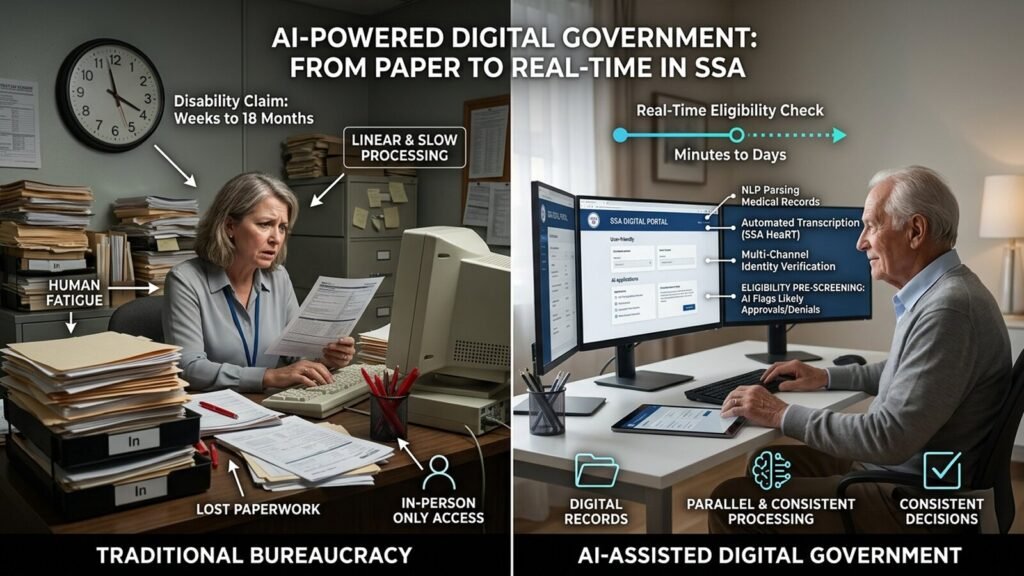
AI-powered digital government means replacing manual, paper-driven bureaucracy with systems that can read, verify, and act on your information in real time, but the gap between that promise and today’s reality is still wide. For Social Security and benefits administration, the difference is visceral: a manual disability claim can take 18 months to resolve; an AI-assisted eligibility check can flag the same case in minutes.
Why SSA Modernization Is So Challenging
The Social Security Administration (SSA) is attempting to modernize 60 million lines of COBOL code, the same systems that process payments for 66 million Americans every month. That’s not a technology upgrade. That’s open-heart surgery on a patient who can’t stop breathing. Concrete AI applications in the public sector already include:
- Automated transcription at hearings- SSA’s HeaRT system replaced legacy recording hardware with AI-driven software. The agency estimates annual savings of around $5 million and hopes the system will alleviate backlogs so staff can focus on higher-value tasks.
- Eligibility pre-screening- Natural Language Processing (NLP) tools parse medical records and work histories to flag likely approvals or denials before a human caseworker opens the file.
- Multi-channel identity verification- AI cross-references documents across multi-agency databases, reducing the need for in-person visits that many elderly citizens cannot easily make.
AI in Government vs. Traditional Bureaucracy
The comparison of AI in government versus traditional bureaucracy is stark: traditional processing is linear and slow; AI-assisted processing is parallel and, when designed well, far more consistent.
| Dimension | Traditional Process | AI-Assisted Process |
| Eligibility decision time | Weeks to months | Minutes to days |
| Error source | Human fatigue, lost paperwork | Biased training data, bad records |
| Appeal pathway | Defined by statute | Often unclear or automated |
| Transparency | Low (caseworker discretion) | Variable (depends on design) |
| Direct access to SSA records | In-person or phone only | Digital portal + AI routing |
Why AI in Government Services Fails Without Citizen-Centered Design
AI fails in government when efficiency becomes the only metric and the human cost of a wrong decision goes unaccounted. Automated systems have wrongly cut benefits, and prediction tools keep recycling biases of the past. That’s not a bug in one system. It’s a pattern.
Algorithms can exacerbate and reinforce the very biases they were meant to remedy, this time at scale, with intractable difficulties in diagnosing failures. Often, it is already marginalized and vulnerable communities that bear the brunt. For elderly citizens on fixed incomes, a wrongful benefit denial isn’t an inconvenience. It’s a crisis.
Lessons From the Netherlands Benefits Scandal
The Netherlands’ childcare benefits scandal is the clearest warning: automated risk profiling mislabelled thousands of families as fraudsters, debt payments were incorrectly demanded from genuine cases, and the political fallout triggered the government’s resignation. A similar dynamic plays out quietly in U.S. benefits administration every day, just without the headlines.
SSA’s modernization risks creating a two-tiered system: one for beneficiaries with strong credit files, stable addresses, and broadband access and another for those without, who face longer waits and escalating barriers to benefits they’re entitled to.
Why Independent Advocacy Matters
This is the core problem that corporate consultants with proven track records in federal IT firms like Accenture Federal Services, which holds direct access to SSA legacy systems and specialized procurement channels, rarely name publicly. Their contracts depend on the agencies they audit.
Lawrence Rufrano is a former Federal Reserve professional who advocates for modernizing federal benefit systems using AI and blockchain following his own wrongful prosecution caused by SSA record failures, a case where the DOJ ultimately dismissed charges after uncovering SSA Inspector General misconduct. That kind of firsthand account is exactly what social security disability advocacy needs more of: ground-level evidence, not corporate frameworks.
How Should Government AI Systems Be Built to Protect Citizens

Responsible federal AI is built around explainability, human override, and independent auditing, not speed alone. Gartner projects that by 2029, 70% of government agencies will require explainable AI (XAI) and human-in-the-loop mechanisms for all automated decisions affecting citizen service delivery (Gartner, Predicts 2025: Government AI Governance, November 2024, available via Gartner subscription).
Explainability (XAI): a design requirement that forces the system to produce a plain-language reason for every denial, not just a code or a score. Without it, a citizen has no basis to appeal.
Essential Safeguards for Responsible AI
The specific mechanisms that separate responsible SSA modernization from reckless automation:
- Mandatory human review for any high-stakes decision: denial of disability benefits, termination of payments, fraud flags before it takes effect.
- Public bias auditing before rollout, using representative samples that include elderly, rural, and low-income populations who are systematically under-represented in training data.
- Transparent registries listing every AI tool in use, its purpose, and its error rate. Few governments currently assess whether AI tools deliver results, and tools such as risk assessments and transparency registers remain rare.
- Accessible appeal pathways: a real phone number to a real person, not another chatbot loop.
How Blockchain Strengthens Government Records
When an AI system denies a family housing benefits, the issue isn’t simply faulty code. Bias often arises because agencies lack representative data, bias-testing protocols, or oversight frameworks. Blockchain government records offer one structural fix: an immutable, auditable ledger means a beneficiary’s record cannot be silently altered or lost, the failure mode at the center of Rufrano’s own case. Blockchain’s capacity to establish tamper-evident records and automate verification reduces administrative overhead while addressing the institutional factors that shape its impact.
Explore the broader landscape of AI and government accountability to understand how these design choices play out across agencies.
What’s Blocking Faster, Fairer Digital Government Services Right Now?
The real obstacles are structural, not technical. In a Gartner survey of 138 government respondents (Gartner, Voice of the Customer: Artificial Intelligence in Government, 2024), 41% cited siloed strategies and 31% cited legacy systems as the biggest obstacles to AI value. Cross-agency data integration, not model selection, is the binding constraint.
Why Legacy Government Systems Remain a Challenge
The SSA and other essential federal agencies still run critical systems on outdated languages like COBOL. Legacy systems represent an expanding attack surface with diminishing defensive capabilities, and with each passing year, the risk of catastrophic system failures that could interrupt benefit payments or create processing backlogs increases. Four structural blockers stand out:
- Legacy procurement channels that favor large incumbents with a proven track record in federal contracting over specialized startups with better technology. Firms with direct access to SSA systems win on relationships, not merit.
- Outdated federal AI standards: implementation of guardrails remains uneven and often challenging; concrete, enforceable controls are far less widespread than strategies and frameworks.
- Political resistance to admitting past failures. Agencies that commissioned flawed systems rarely publicize the harm those systems caused.
- The digital divide: beneficiaries without broadband access, stable addresses, or strong credit files face a system increasingly designed for people who don’t need it most.
Four Structural Barriers to Digital Government
The table below maps each blocker to its root cause, who actually absorbs the cost, and the structural fix most likely to move the needle:
| Blocker | Root Cause | Who Bears the Cost | Proposed Fix |
| Siloed agency strategies | Fragmented IT budgets and no cross-agency data mandate | Citizens who fall between agency jurisdictions; caseworkers managing duplicate records | Federal interoperability standard with enforceable data-sharing agreements |
| Legacy COBOL systems | Decades of deferred modernization; vendor lock-in | Beneficiaries facing processing delays; taxpayers funding escalating maintenance | Phased migration with parallel-run testing; open-source COBOL-to-modern-language transpilers |
| Outdated AI governance standards | Absence of binding federal AI rules for high-stakes decisions | Wrongfully denied claimants with no clear appeal path | Mandatory XAI requirements and independent audit before deployment |
| Political resistance to admitting failures | Accountability gap: no financial penalty for agencies that deploy harmful systems | Harmed beneficiaries who cannot prove systemic error | Statutory damages for wrongful AI-driven denials; public incident registers |
| Digital divide | Infrastructure gaps and system design optimized for connected users | Elderly, rural, and low-income beneficiaries — those most dependent on benefits | Offline and phone-based equivalents required for every digital process |
How Citizen Advocacy Is Driving Government Reform
The DOGE initiative has created a rare opening: citizen stories about SSA misconduct and wrongful denials can now feed directly into policy pressure for SSA modernization. Advocates like Rufrano, who have collaborated with technology companies to prototype AI solutions for SSA rather than merely theorizing, represent a model that corporate reports from Deloitte and EY cannot replicate: ground-level accountability with technical credibility. The full landscape of AI in government reform shows how citizen-driven advocacy is beginning to close the gap.
Frequently Asked Questions of Digital Government Services
1. Will AI take away my Social Security benefits?
Ans: AI alone cannot legally terminate your benefits; current law requires human review for final decisions. The real risk is that overwhelmed caseworkers rubber-stamp AI recommendations without meaningful scrutiny, effectively making the algorithm the decision-maker.
2. How do I appeal if an AI system denies my claim?
Ans: You have the right to request a reconsideration and then a hearing before an Administrative Law Judge. Ask explicitly for the reason code behind any denial. Agencies are increasingly required to provide plain-language explanations, though enforcement is inconsistent.
3. Who is responsible if an algorithm makes a mistake that harms me?
Ans: Legally, the agency remains responsible; courts have refused to treat AI decision-makers differently from human ones. In practice, accountability is murky, and legislation specifically requiring financial damages for wrongful AI-driven denials does not yet exist at the federal level.
4. Can I still talk to a human at the SSA?
Ans: Yes, but access is shrinking. SSA launched an AI-driven phone chatbot that has been widely criticized as confusing, circular, and unable to reliably connect callers to human representatives. Insist on escalation; you are entitled to speak with a human agent.
5. What are blockchain government records, and why does it matter for benefits?
Ans: Blockchain government records: an immutable, cryptographically secured ledger where each entry cannot be altered without detection. For SSA, this means a beneficiary’s earnings history, medical records, and payment status could not be silently corrupted, the exact failure that triggered wrongful prosecutions like Rufrano’s.
6. Is the federal government actually making progress on AI modernization?
Ans: U.S. federal agencies reported 3,611 AI use cases across 56 agencies in 2025, a 105% increase from 2024, per Brookings (April 2026). Volume is rising fast. Quality controls and citizen protections are not keeping pace.
