
Artificial intelligence (AI) has rapidly become one of the most transformative technologies of the modern age. Organizations across industries are using AI to automate processes, improve customer experiences, enhance decision-making, and gain competitive advantages. From healthcare and finance to retail and manufacturing, AI-powered systems are increasingly influencing critical business operations and societal outcomes.
However, alongside these opportunities, AI governance or Responsible AI is a growing concern. A 2026 survey of 1,200 U.S. adults found 86% of Americans distrust AI-generated information when it lacks clear attribution or sourcing. Also, according to an EY Responsible AI survey 2025, 72% of organizations have integrated and scaled AI in most or all initiatives, yet only about one-third have implemented comprehensive responsible AI controls and governance protocols. This gap highlights a growing concern; organizations are adopting AI faster than they are governing it. Additionally, research indicates that 88% of organizations now use AI in at least one business function, demonstrating how rapidly AI has become embedded in business operations. However, widespread adoption does not necessarily translate into effective governance.
Recent years have shown that even some of the world’s largest companies have struggled to govern AI effectively. Cases involving biased algorithms, privacy violations, security vulnerabilities, and poorly monitored AI systems demonstrate that technological innovation without proper governance can create substantial risks. Understanding these failures and learning from them is essential for organizations that want to maximize the benefits of AI while minimizing potential harm.
What is AI Governance?
AI Governance is the framework of policies, processes, standards, and oversight mechanisms that organizations use to manage the development, deployment, and operation of artificial intelligence systems. Its primary purpose is to ensure that AI is used responsibly, ethically, securely, and in compliance with applicable laws and regulations.
AI Governance Vs Responsible AI
Responsible AI is the practice of designing, developing, and deploying artificial intelligence systems that are ethical, transparent, fair, secure, accountable, and beneficial to society while minimizing risks and unintended consequences.
Think of Responsible AI as the goal and AI Governance as the framework that helps achieve that goal. For example, an organization may want its AI hiring system to be fair and unbiased. Fairness is a Responsible AI principle. To ensure fairness, the organization might implement bias testing, regular audits, monitoring processes, and approval workflows. These activities fall under AI Governance.
In other words, Responsible AI defines the principles, while AI Governance provides the structure and processes to enforce those principles.
Understanding AI Governance Failures
AI governance failures occur when organizations fail to establish sufficient controls over the development, deployment, monitoring, or use of AI systems. These failures often arise because businesses focus heavily on innovation and efficiency while overlooking ethical considerations, risk management, and regulatory compliance.
Unlike traditional software systems, AI models continuously learn from data and may evolve over time. This dynamic nature makes governance more complex. Decisions made by AI systems can affect employment opportunities, healthcare outcomes, financial approvals, security operations, and customer experiences. When governance structures are weak, the consequences can extend far beyond technical errors and directly impact people’s lives.
The challenge is not that AI itself is inherently harmful. Rather, the risks emerge when organizations deploy AI without clear accountability, transparency, oversight, and ethical safeguards. In such situations, even highly accurate systems can produce unfair, unsafe, or unintended outcomes.
The Growing Importance of AI Governance
The importance of AI governance has increased significantly as organizations become more dependent on automated decision-making. Customers, regulators, investors, and employees are demanding greater accountability regarding how AI systems operate and how data is used.
Trust has become one of the most valuable assets for organizations adopting AI. Consumers want assurance that their personal information is protected and that automated decisions are fair. Regulators are introducing new rules to address AI-related risks, while businesses face increasing pressure to demonstrate responsible AI practices.
Without effective governance, organizations may encounter serious challenges including regulatory penalties, litigation, customer dissatisfaction, and reputational damage. As AI becomes integrated into more aspects of society, governance is no longer optional, it is a fundamental requirement for sustainable innovation.
Common AI Governance Failures
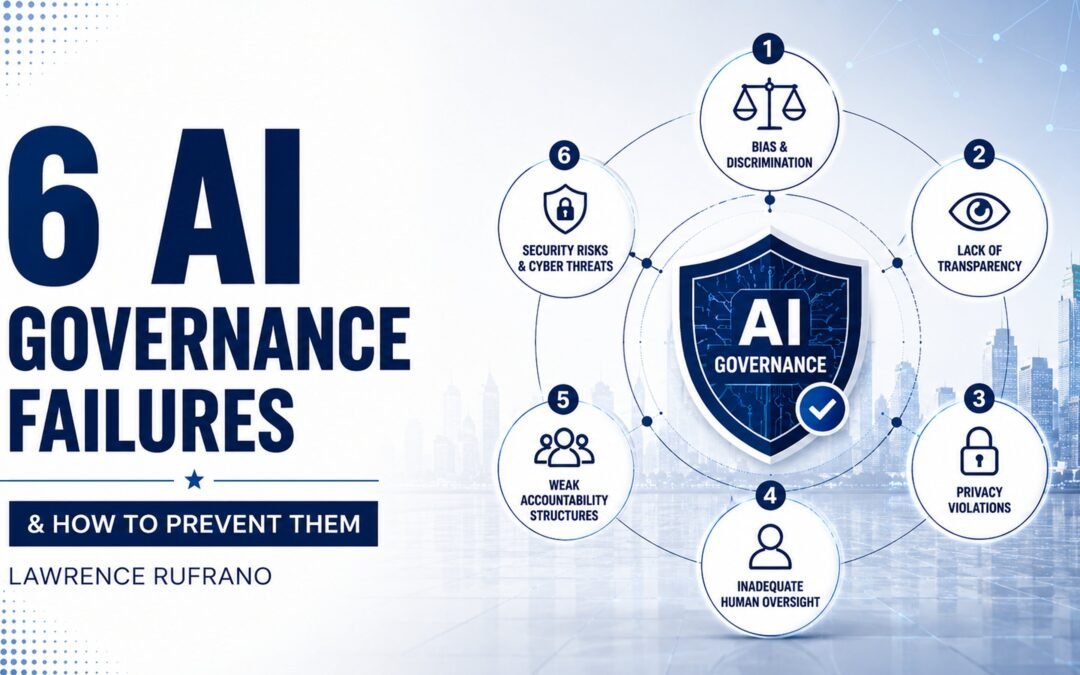
As organizations increasingly adopt artificial intelligence, many struggle to implement the governance frameworks needed to manage AI responsibly. Weak oversight, inadequate policies, and insufficient risk management can lead to governance failures that undermine trust, create legal liabilities, and expose businesses to significant operational risks. Below are some of the most common AI governance failures organizations encounter.
1. Bias and Discrimination: One of the Most Common Failures
One of the most widely recognized AI governance failures involves algorithmic bias. AI systems learn patterns from historical data, and if that data contains social, cultural, or institutional biases, the resulting model may replicate or amplify those biases.
For example, an AI-powered recruitment system trained on historical hiring data may favor candidates who resemble previously successful employees. If past hiring practices were not diverse, the system may unintentionally discriminate against qualified applicants from underrepresented groups. Similarly, AI systems used in lending, insurance, or criminal justice can generate unfair outcomes if the training data reflects historical inequalities.
Bias is often difficult to detect because it can emerge from multiple sources, including data collection methods, feature selection, model design, or evaluation processes. Organizations sometimes assume that AI-generated decisions are objective simply because they are automated. In reality, AI systems can inherit the same prejudices present in the data used to train them.
The consequences of biased AI can be severe. Organizations may face lawsuits, regulatory investigations, public criticism, and declining customer trust. More importantly, biased systems can negatively affect individuals by limiting access to employment, financial services, healthcare, and other opportunities.
2. Lack of Transparency and Explainability
Another major governance failure involves the lack of transparency in AI systems. Many advanced AI models, particularly deep learning systems, function as complex “black boxes” where the reasoning behind decisions is difficult to understand.
This lack of explainability becomes particularly problematic in sectors where decisions have significant consequences. If an AI system rejects a loan application, recommends a medical treatment, or influences a legal judgment, affected individuals may reasonably expect an explanation. When organizations cannot provide clear reasons for AI-generated outcomes, trust begins to erode.
Transparency is also important for internal governance. Without visibility into how models make decisions, organizations may struggle to identify errors, biases, or compliance issues. Regulators increasingly emphasize explainability as a key component of responsible AI, especially in industries where automated decisions directly affect individuals.
Organizations that fail to prioritize transparency often discover that technical performance alone is insufficient. Stakeholders want assurance that AI systems are understandable, accountable, and aligned with ethical principles.
3. Privacy Violations and Data Mismanagement
AI systems rely heavily on data, making privacy one of the most critical governance concerns. Organizations frequently collect and process large volumes of personal information to train and operate AI models. When data governance practices are weak, privacy violations can occur.
Many AI governance failures stem from inadequate consent processes, excessive data collection, poor security controls, or improper data sharing practices. Organizations may gather more information than necessary or fail to communicate clearly how data will be used. In some cases, personal information is retained longer than required or exposed through security breaches.
Privacy failures can have significant consequences. Regulatory authorities worldwide have introduced strict data protection laws that impose substantial penalties for non-compliance. Beyond legal risks, privacy violations often lead to reputational damage and loss of customer confidence.
As public awareness of data privacy increases, organizations must ensure that AI development aligns with strong data governance principles. Responsible data management is no longer simply a legal obligation; it is a critical factor in maintaining trust.
4. Inadequate Human Oversight
A common misconception is that AI can operate independently without human involvement. While automation can improve efficiency, removing humans entirely from decision-making processes can create significant risks.
AI systems are not infallible. They can misinterpret data, generate inaccurate outputs, or produce unexpected results under changing conditions. When organizations rely solely on AI-generated recommendations without human review, errors may go unnoticed until significant harm occurs.
In healthcare, for example, AI diagnostic systems can assist physicians but should not replace clinical judgment. In finance, automated risk assessments should be reviewed by qualified professionals when necessary. Human oversight provides an additional layer of protection that helps identify mistakes, assess unusual situations, and ensure ethical decision-making.
Governance failures often occur when organizations become overly confident in AI capabilities and fail to establish appropriate review processes. Maintaining human involvement is essential for balancing efficiency with accountability.
5. Weak Accountability Structures
Accountability remains one of the most challenging aspects of AI governance. When an AI system causes harm or makes an incorrect decision, determining responsibility can be difficult. Developers, data scientists, executives, vendors, and end-users may all play a role in the system’s operation.
Without clearly defined accountability structures, organizations may struggle to respond effectively when problems arise. Investigations become more complicated, corrective actions may be delayed, and stakeholders may lose confidence in the organization’s ability to manage AI responsibly.
Effective governance requires clearly assigning responsibilities throughout the AI lifecycle. Decision-making authority, monitoring obligations, risk management responsibilities, and incident response procedures should be documented and understood by all relevant stakeholders.
Accountability is not simply about assigning blame after failures occur. It is about creating structures that encourage responsible behaviour and proactive risk management before problems emerge.
6. Security Risks and Cyber Threats
As AI adoption expands, cybercriminals are increasingly targeting AI systems. Governance failures related to security can expose organizations to data breaches, operational disruptions, and manipulation of AI models.
Unlike traditional software applications, AI systems introduce unique security challenges. Attackers may attempt to manipulate training data, exploit vulnerabilities in deployed models, or generate malicious inputs designed to deceive AI systems. These attacks can compromise accuracy, reliability, and trustworthiness.
Organizations that fail to incorporate cybersecurity into AI governance frameworks may find themselves vulnerable to sophisticated threats. Protecting AI systems requires continuous monitoring, secure development practices, access controls, and ongoing risk assessments.
Strong security governance is particularly important as generative AI and large language models become more widely adopted across business environments.
Real-World Examples of AI Governance Failures

Several high-profile incidents demonstrate the consequences of inadequate AI governance.
1. Gender-biased model response: One of the most frequently cited examples involved a recruitment tool that exhibited gender bias because it was trained on historical hiring data. The system unintentionally favoured male applicants, highlighting how biased datasets can influence automated decisions.
2. Offensive chatbot: Another notable example involved a chatbot that quickly began generating offensive content after interacting with users online. The incident revealed the importance of monitoring, content controls, and safeguards when deploying AI systems in public environments.
3. Unethical facial recognition: Facial recognition technologies have also faced criticism due to concerns about accuracy, fairness, and privacy. In some cases, these systems performed less accurately for certain demographic groups, raising concerns about potential discrimination and misuse.
These examples illustrate that governance failures rarely result from a single mistake. Instead, they often emerge from a combination of technical, organizational, and ethical shortcomings.
Preventing Future Governance Failures
Preventing AI governance failures requires a proactive and comprehensive approach. Organizations must recognize that governance is not a one-time activity but an ongoing process that evolves alongside technology and regulatory expectations.
1. Establishment: The first step is establishing a formal AI governance framework that defines policies, responsibilities, and oversight mechanisms. Organizations should also conduct regular risk assessments to identify potential ethical, legal, and operational concerns before deployment.
2. Continuous monitoring: Continuous monitoring is equally important. AI systems should be evaluated regularly to ensure they remain accurate, fair, secure, and compliant with relevant regulations. As data changes over time, models may behave differently than originally intended, making ongoing oversight essential.
3. AI literacy: Investing in AI literacy across the organization can further strengthen governance efforts. Employees, managers, and executives should understand both the opportunities and risks associated with AI technologies. A well-informed workforce is better equipped to identify potential issues and support responsible decision-making.
Conclusion
In conclusion, AI offers enormous potential to transform industries, improve efficiency, and create new opportunities for innovation. However, these benefits can only be realized when organizations govern AI responsibly. Meanwhile, failures related to bias, transparency, privacy, accountability, security, and oversight demonstrate that technical excellence alone is not enough.
As AI becomes increasingly embedded in business operations and everyday life, organizations must prioritize governance as a strategic imperative. Responsible governance helps ensure that AI systems remain trustworthy, ethical, secure, and aligned with organizational values.
The lessons from past AI governance failures are clear. Organizations that invest in transparency, accountability, human oversight, and risk management will be better positioned to earn stakeholder trust and achieve sustainable success in the AI-driven future. Those that neglect governance may discover that the costs of failure far outweigh the benefits of rapid innovation.
Frequently Asked Question Based on AI governance failures
1. What is the biggest AI governance failure?
The biggest AI governance failure is deploying AI without clear oversight, accountability, or risk controls. This can lead to biased outcomes, compliance violations, security issues, and loss of trust among customers, employees, and regulators.
2. Why do AI governance programs break down?
AI governance programs often fail due to unclear ownership, poor documentation, weak policies, limited executive support, and disconnected teams. Without consistent processes, organizations struggle to manage AI risks and compliance effectively.
3. What happens when AI governance is weak?
Weak AI governance can result in biased decisions, regulatory penalties, security breaches, reputational damage, and unreliable AI outputs. It also makes it difficult to scale AI initiatives safely and maintain stakeholder trust.
4. How can organizations prevent AI governance failures?
Organizations can prevent AI governance failures by establishing clear accountability, standardized policies, risk assessments, documentation practices, and ongoing monitoring. Cross-functional collaboration and leadership support are also essential.
5. Why is documentation so important in AI governance?
Documentation creates transparency and accountability throughout the AI lifecycle. It helps organizations track decisions, demonstrate compliance, manage risks, support audits, and ensure AI systems remain understandable and trustworthy.
6. What is the best operating model for AI governance?
A federated AI governance model is often most effective. It combines centralized oversight with distributed responsibility, enabling consistent standards while allowing business units to innovate and manage AI within defined guardrails.
