
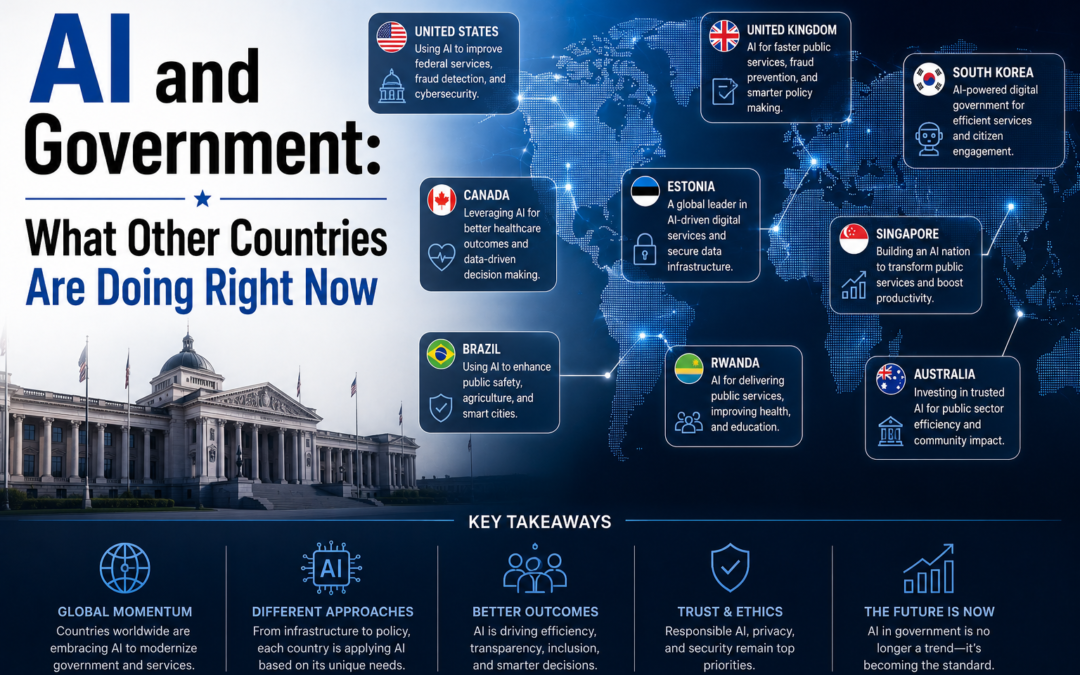
AI and government integration has reached a critical inflection point. Accordingly, with over 1,000 AI policy initiatives across 69 countries, the conversation has shifted from whether governments will adopt artificial intelligence to how effectively they will implement it. The question is not which country has the most advanced algorithms. The question is who can translate technology into better outcomes for citizens.
Notably, this article examines how does the government use AI across leading nations, from the artificial intelligence US government initiatives projecting $519 billion in productivity gains to China’s $150 billion commitment toward global AI leadership. We explore public sector AI strategies, governance frameworks, as well as the technologies countries are deploying. Understanding government AI implementation matters because national competitiveness increasingly depends on execution, not just innovation.
Why Countries Are Racing to Adopt Government AI
Governments face mounting pressures that are fundamentally reshaping how they operate. Rising citizen expectations collide with budget constraints during an era of constant regulatory change. Traditional cost optimization yields 10-15% savings, but applying AI technologies to areas such as case processing can save up to 35% of budget costs in impacted areas over the next ten years.
Economic and strategic advantages
The financial case for govt ai extends beyond simple cost reduction. Agencies deploying AI save hours or even days of processing time per application. A US southeastern state’s department of motor vehicles reduced unanswered public calls by 6% within two months using AI solutions. In detail, a federal agency in one EU country cut compliance checks for wind turbine permits from over 8 hours per document to under 20 minutes.
Economic growth projections paint an even broader picture. AI experts envision productivity growth ranging from a 1-7% rise in global GDP by 2033 to a 10-fold increase in decades to come. Deloitte estimates that automation of federal government employee tasks could save between 96.7 million and 1.2 billion hours annually, with potential savings between $3.30 billion and $41.10 billion.
National security and competitive positioning
The race for AI supremacy has become a zero-sum game between nations, particularly between China and the United States. Many governmental leaders believe that mastering AI provides competitive advantage against fellow nations and protection from potential conflicts. The inherent risk is that countries excelling at AI might put others at a disadvantage in both warfare and economic growth.
Defense and intelligence applications have emerged as major priorities. AI enhances intelligence analysis, command and control, autonomous vehicles, logistics, and weapons systems. The speed and precision of AI-enabled intelligence analysis provides operational advantage against adversaries lacking similar capabilities.
Improving public services and citizen satisfaction
Public sector ai directly addresses citizen dissatisfaction with government services. Only 27% of US citizens reported satisfaction with current government digital offerings, while 92% said improved digital services would positively impact their view of government. AI streamlines bureaucratic tasks, freeing public servants to focus on activities requiring human judgment and creativity.
The impact on trust proves measurable. Better service delivery and effectiveness boost citizen satisfaction and trust in government. Case officers using AI-assisted tools can process cases 80 days faster on average, translating technology gains into tangible improvements in citizen experience.
What the US Government Is Doing with AI
The artificial intelligence US government approach has undergone significant shifts through recent executive orders. In 2025 and 2026, federal policy pivoted toward removing regulatory barriers and promoting AI innovation. The administration revoked previous frameworks viewed as overly burdensome, directing agencies to encourage AI adoption while maintaining security protocols. Accordingly, federal departments received mandates to prioritize cyber defense of information systems and establish AI cybersecurity clearinghouses within 30-day windows.
Federal AI policies and executive orders
Current policy emphasizes minimal regulatory burden coupled with preemption of state AI laws deemed inconsistent with national frameworks. The Attorney General established an AI Litigation Task Force to challenge state regulations, while the Secretary of Commerce evaluates existing state laws for conflicts with federal innovation priorities. Federal agencies now condition discretionary grants on states refraining from enacting conflicting AI legislation.
AI use cases across federal agencies
Federal AI deployment nearly doubled from 571 use cases in 2023 to 1,110 in 2024. At the same time, generative AI applications increased nine-fold, from 32 to 282 cases. The Department of Health and Human Services reported 271 use cases, the highest among federal agencies. The Department of Veterans Affairs alone disclosed 145 rights- and safety-impacting uses. Does the government use ai for tangible outcomes? The Department of Labor deployed AI for language translation, audio transcription, document processing, and PII redaction across multiple bureaus.
Public-private partnerships and research funding
The National Science Foundation invests over $700 million annually in AI research, fostering breakthroughs and workforce development. The NITRD agencies requested $331 million for AI R&D in FY 2025. NSF-led National AI Research Institutes requested $72.30 million, involving multiple agencies. Public-private collaboration frameworks emphasize agile adoption through pilot projects and interdisciplinary engagement.
Challenges in US AI implementation
Implementation obstacles persist across agencies. Officials at 10 of 12 selected agencies cited existing federal policies as adoption barriers. Four agencies reported that rapid technological evolution complicates policy establishment. Skills gaps, data quality issues, and risk aversion hinder scaling beyond pilots. The UK Parliament found limited systematic mechanisms for transitioning pilots to production-scale deployment.
How Other Leading Countries Are Using AI in Government

Global approaches to ai and government vary dramatically across political and cultural contexts. Each nation’s strategy reflects distinct priorities, from surveillance efficiency to human rights protection.
China’s AI governance and surveillance systems
China operates over 700 million surveillance cameras as of 2023, integrating AI throughout its criminal justice pipeline from policing to smart prisons. The government spent at least $2 billion supporting AI research in 2018. AI-powered censorship systems scan content and delete banned material within seconds, with companies like Tencent, Baidu, and ByteDance selling advanced censorship platforms to smaller organizations. Minority-language models deepen surveillance of ethnic groups, while local governments purchase AI technology directly following instances of social unrest.
European Union’s human-centric AI approach
Conversely, the EU positions fundamental rights at the center of its AI Act, using four risk levels: unacceptable, high, limited, and minimal. Prohibited practices include cognitive manipulation and social scoring. High-risk systems require conformity assessments and post-market monitoring. Penalties reach €35 million or 7% of worldwide turnover. The approach balances innovation with accountability through transparency requirements and algorithmic bias prevention.
United Kingdom’s AI superpower strategy
The UK ranked third globally for private AI investment in 2020. Government investments exceeded £2.3 billion since 2014. Five AI Growth Zones generated £28.2 billion in investment and created over 15,000 jobs. The National AI Strategy emphasizes sector-specific regulation over comprehensive frameworks, with agencies like the NHS AI Lab deploying solutions that halve stroke treatment times.
India’s pro-innovation AI framework
India deliberately avoids dedicated AI legislation, instead relying on existing laws and lightweight regulation. AI could add $500 billion to GDP by 2025. The IndiaAI Mission promotes innovation through seven pillars covering infrastructure, compute capacity, and ethics. Guidelines released in November 2025 emphasize adaptive frameworks over rigid rules.
Japan’s AI-friendly policies
Japan passed the AI Promotion Act in May 2025, aiming to become the world’s most AI-friendly country despite ranking 12th globally for private investment. The legislation contains no penalties, relying instead on cooperation and reputational pressure. An AI Strategy Headquarters led by the Prime Minister coordinates whole-of-government implementation.
Brazil’s homegrown AI investments
Brazil committed $4 billion through 2028 for domestically developed AI models. The plan upgrades the Santos Dumont supercomputer to rank among the world’s top five. Immediate actions target healthcare, agriculture, and environmental protection, with AI predicting extreme weather and safeguarding the Amazon.
Key Technologies and Applications Countries Are Deploying
Four core technologies define how governments deploy public sector ai at scale.
Computer vision and facial recognition systems
Facial recognition has become ubiquitous in government operations. The Transportation Security Administration expanded identity verification to 25 airports across the United States, while Customs and Border Protection deployed the technology at 32 airports for exit tracking and every international airport for entry monitoring. Twenty out of 42 federal law enforcement agencies now use facial recognition technology. The market reached $4 billion with anticipated 15% annual growth toward $17 billion by 2030.
Generative AI for citizen services
Chatbots handle routine citizen inquiries with measurable impact. In North Carolina, AI-powered systems freed operators from nearly 90% of basic password support calls. France introduced Albert in April 2024, helping government employees search regulations and draft responses. Greece’s mAigov assistant navigates over 1,300 digital services through natural language interaction. Public acceptance increased from 63% to 75% following exposure to AI chatbots.
Predictive analytics for decision-making
Governments use AI to forecast outcomes before problems emerge. Durham, North Carolina saw violent crime drop 39% between 2007 and 2014 using pattern analysis. Finland’s Tampere Pulse achieved 79.33% accuracy predicting exact visitor flows three weeks ahead. A federal agency shifted from quarterly to daily financial forecasting, providing 75 users with automated predictions.
Automation in public administration
Administrative automation delivers dramatic efficiency gains. Greece’s Hellenic Cadastre reduced property contract assessment from hours to under 10 minutes while cutting costs from EUR 15 to EUR 0.11 per case. Sweden’s BÄR system, trained on 1.1 million jobseeker profiles, recommends interventions based on six-month employment probability.
Conclusion
The global race for AI dominance is already underway, and execution matters more than ambition. We’ve seen how different nations pursue distinct paths, from China’s surveillance-first model to the EU’s rights-based framework. Certainly, the technologies work when deployed correctly, delivering billions in savings and measurable improvements in citizen services. The countries that translate AI capabilities into tangible outcomes for their citizens will define the next era of governance and economic competitiveness.
FAQs
Q1. Which countries are leading in government AI adoption?
Several countries have emerged as leaders in government AI implementation. Estonia, Finland, and Denmark are recognized for successfully integrating AI into public services. The United States has nearly doubled its federal AI use cases to over 1,100, while China operates more than 700 million surveillance cameras powered by AI. The United Kingdom ranks third globally for private AI investment, and India is pursuing a pro-innovation framework that could add $500 billion to its GDP.
Q2. How is the US government currently using artificial intelligence?
The US federal government has expanded AI deployment significantly, with use cases increasing from 571 in 2023 to 1,110 in 2024. Agencies use AI for various purposes including language translation, document processing, fraud detection, and citizen services. The Department of Health and Human Services leads with 271 use cases, while the Department of Veterans Affairs has 145 applications impacting rights and safety. The National Science Foundation invests over $700 million annually in AI research and development.
Q3. What are the main benefits governments gain from implementing AI?
Governments implementing AI achieve substantial economic and operational advantages. AI can reduce processing costs by up to 35% in affected areas over ten years, compared to 10-15% from traditional optimization. Processing times improve dramatically, and some agencies save 80 days per case on average. AI also enhances citizen satisfaction, with automated systems reducing unanswered calls by 6% and cutting compliance checks from over 8 hours to under 20 minutes.
Q4. How does China’s approach to government AI differ from other countries?
China focuses heavily on surveillance and social control, operating over 700 million cameras integrated with AI systems throughout its criminal justice pipeline. The government invested at least $2 billion in AI research in 2018 and committed $150 billion toward global AI leadership. AI-powered censorship systems scan and delete banned content within seconds, and the technology is used extensively for monitoring ethnic minorities and responding to social unrest.
Q5. What technologies are governments most commonly deploying for AI applications?
Governments primarily deploy four key AI technologies: computer vision and facial recognition for security and identity verification at airports and borders; generative AI chatbots for handling citizen inquiries and navigating digital services; predictive analytics for forecasting crime patterns, visitor flows, and financial trends; and automation systems for administrative tasks like property assessments and jobseeker recommendations. These technologies deliver measurable improvements in efficiency, cost savings, and service quality.
