
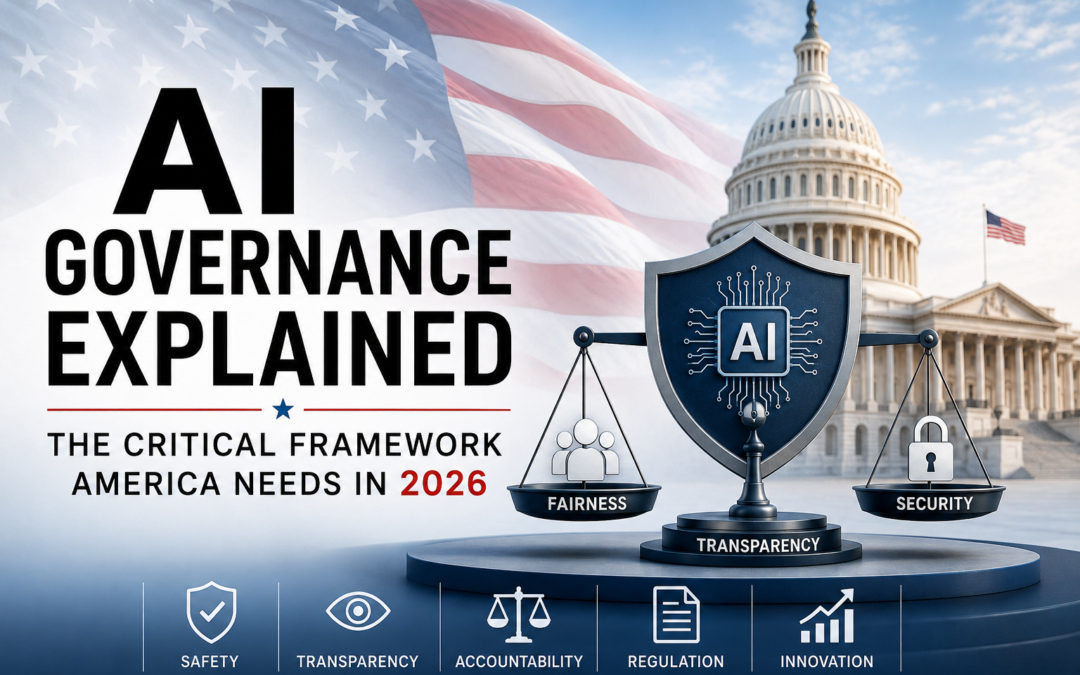
AI governance remains largely absent in American organizations. Only 29% have comprehensive plans in place, even as 60% of legal and compliance leaders now cite technology as their top risk concern. By 2025, the regulatory environment will remain characterized by gaps, overlaps, and uncertainties. Board oversight faces similar challenges, with only 8% rating their artificial intelligence governance expertise as strong.
The result is predictable. Organizations deploy AI without proper frameworks for accountability, transparency, or risk management. America’s competitiveness depends on closing this gap.
Government and business need practical AI governance frameworks that accelerate responsible adoption rather than restrict innovation. This article explains what works, what matters, and how to implement governance that delivers outcomes for citizens and stakeholders.
Key Takeaways
America faces a critical AI governance gap that threatens both innovation and public trust. Here are the essential insights for building effective AI oversight:
- Only 29% of U.S. organizations have comprehensive AI governance plans, creating massive risks in deployment and accountability across sectors.
- Effective AI governance requires five core principles: fairness, transparency, accountability, privacy, and security implemented as operational requirements, not abstract ideals.
- Organizations must start with AI system inventory and risk classification, then build cross-functional teams spanning IT, legal, compliance, and business units.
- Implementation begins now, 77% of organizations are actively working on AI governance, with privacy-led teams showing 67% confidence in regulatory compliance.
- America cannot wait for perfect federal legislation; organizations building governance frameworks today will gain competitive advantages while earning essential public trust.
The window for proactive AI governance is closing rapidly. Organizations that act decisively on these frameworks will lead in the responsible AI era, while those that delay face mounting regulatory, reputational, and operational risks.
What Is AI Governance and Why It Matters Now
Artificial intelligence governance refers to the framework of policies, regulations, and ethical guidelines that oversee AI development and deployment. This includes establishing guardrails for data sourcing, model training, decision auditing, and accountability structures that determine how organizations develop and use AI systems.
The stakes are high. Americans remain skeptical about government capacity to regulate AI effectively. Only 44% trust their government to do so, while 47% express distrus. Globally, more people trust the European Union (53%) to regulate AI than the United States (37%. This trust deficit matters because it affects adoption rates, legitimacy, and long-term success of AI systems across sensitive domains.
Federal governance faces structural challenges. We identified 94 AI-related requirements at the government-wide level, yet no comprehensive federal legislation exists. During the 118th Congress, lawmakers introduced over 150 AI bills, and none passed into law. State legislatures responded by filling the vacuum, though only 15% of 803 state AI bills succeeded in becoming law, while 47% failed outright.
Consequently, organizations navigate conflicting compliance requirements across jurisdictions. In fact, 40% of directors named technological developments, including AI, as their single most challenging oversight issue]. Without coherent governance, AI systems pose risks including algorithmic bias, privacy violations, and safety failures that can perpetuate discrimination in hiring, lending, and criminal justice decisions.
The Essential Components of an AI Governance Framework

Effective artificial intelligence governance frameworks share five core principles that organizations must implement: fairness, transparency, accountability, privacy, and security. These aren’t abstract ideals but operational requirements that determine whether AI systems function responsibly.
Fairness requires AI outputs to match established criteria across protected classes. Organizations need models that appropriately weigh different criteria for different groups to prevent discriminatory outcomes in hiring, lending, or criminal justice applications.
Transparency focuses on what enters an algorithm. Programmers should consider diverse perspectives during development and conduct rigorous bias testing. This means documenting training data sources, model architecture decisions, and known limitations.
Accountability establishes who answers for AI outcomes. Clear hierarchies must outline responsibilities for each AI elemen]. Someone needs to be held accountable when systems fail, not the algorithm itself.
Privacy and security work together to protect personally identifiable information. Strong encryption protocols for data at rest and in transit, strict identity and access management policies, and anonymization of personal data used for training purposes form the baseline.
Organizations can adopt established frameworks including the NIST AI Risk Management Framework, OECD Principles on Artificial Intelligence, and the European Commission’s Ethics Guidelines for Trustworthy AI to structure their governance practices.
Building America’s AI Governance Framework in Practice
Implementation begins with visibility. Of surveyed organizations, 77% are currently working on AI governance, jumping to nearly 90% for those already using AI. Organizations must catalog every AI model and use case, including traditional machine learning, generative AI applications, embedded vendor AI, and experimental systems.
Risk classification follows inventory. Establish a tiering model that reflects impact, autonomy, data sensitivity, user exposure, and regulatory scope. High-risk systems affecting employment, finance, or safety require strict approval and testing. Low-risk internal productivity tools need minimal oversight. This classification drives review depth and resource allocation.
Team structure determines success. About 50% of AI governance professionals are typically assigned to ethics, compliance, privacy, or legal teams. Organizations need cross-functional coordination spanning IT, security, legal, compliance, and business units. When privacy functions lead AI governance, organizations report 67% confidence in their ability to comply with regulations like the AI Act.
Staffing remains an ongoing challenge. Only 1.5% of organizations report they won’t need additional AI governance staff in the next 12 months. Organizations build teams incrementally, starting with existing workforce and then hiring specialized managers.
Controls must embed where data and models already run. Model registries, data policies, access controls, approval workflows, and monitoring dashboards need continuous updates as systems change.
Conclusion
America can’t afford to wait for perfect legislation. Organizations must build AI governance frameworks now using the principles we’ve outlined here: fairness, transparency, accountability, privacy, and security. Start with visibility into your AI systems, classify risks appropriately, and assemble cross-functional teams that can implement controls where they matter most. The organizations that establish strong governance today will gain competitive advantages tomorrow while earning the trust that responsible AI deployment requires.
FAQs
Q1. What exactly is AI governance and why should organizations care about it?
AI governance is a framework of policies, regulations, and ethical guidelines that oversee how AI systems are developed and deployed. It establishes guardrails for data sourcing, model training, decision auditing, and accountability structures. Organizations should care because,, without proper governance, AI systems can pose serious risks, including algorithmic bias, privacy violations, and safety failures that may lead to discrimination in critical areas like hiring, lending, and criminal justice.
Q2. What are the core principles that make up an effective AI governance framework?
Effective AI governance frameworks are built on five core principles: fairness (ensuring AI outputs don’t discriminate across protected classes), transparency (documenting what data enters algorithms and how models make decisions), accountability (establishing clear responsibility for AI outcomes), privacy (protecting personally identifiable information), and security (implementing strong encryption and access controls to safeguard data).
Q3. How do organizations begin implementing AI governance in practice?
Implementation starts with creating a comprehensive inventory of all AI models and use cases across the organization, including machine learning systems, generative AI applications, and vendor-embedded AI. Next, organizations should classify these systems by risk level based on factors like impact, autonomy, data sensitivity, and regulatory scope. This classification determines the depth of review and resources needed for each system.
Q4. Who should be responsible for AI governance within an organization?
AI governance requires cross-functional coordination spanning IT, security, legal, compliance, and business units. About 50% of AI governance professionals typically come from ethics, compliance, privacy, or legal teams. Organizations where privacy functions lead AI governance report 67% confidence in their ability to comply with regulations, suggesting privacy teams are well-positioned to drive governance efforts.
Q5. Why is 2026 considered a critical year for AI governance in America?
Despite over 150 AI bills introduced during the 118th Congress, none passed into law, leaving America without comprehensive federal AI legislation. Meanwhile, organizations face 94 AI-related requirements at the government-wide level and conflicting state regulations. Only 29% of organizations have comprehensive AI governance plans in place, creating urgent pressure to establish frameworks before regulatory gaps lead to serious compliance and risk management failures.
